Does My Child Need Therapy? 10 Signs It May Be Time to Get Help

Does My Child Need Therapy

The anxiety that keeps growing. The meltdowns that feel bigger than they should. The school refusal. The sadness. The social struggles. If you’re asking whether this is a phase or something more — you’re already paying attention the way thoughtful parents do.

✍️ Dr. Aryeh Berlin, PsyD
🕑 10 min read
📅 Updated 2026
🔬 Evidence-Based
⭐ Trusted by Bergen County Families

You’re not an alarmist. You’re a parent paying attention. And the question you keep circling back to — does my child actually need therapy, or is this just a phase? — is an important question.

It’s also one that most parents are left to answer alone. At Aspire Psychological Group, we help families throughout Bergen County, NJ and Rockland County, NY — including Ridgewood, Franklin Lakes, Wyckoff, Ramsey, Upper Saddle River, New City, and surrounding communities — answer this question every day, with clarity, compassion, and evidence-based expertise.

You don’t need a crisis to seek help. You only need a concern. Here’s what the research actually says about when to act, and when to watch and wait.

Wondering If Aspire Is the Right Fit for Your Family?

Reach out to our intake team — it’s a low-key way to share what’s going on, ask questions about how we work, and see if we’d be a good match. No pressure, no commitment.

Parent-only sessions available
No diagnosis required to start
Telehealth throughout NJ & NY
Discreet, confidential care

Aspire is a private-pay practice. Many families receive partial reimbursement through out-of-network benefits — we’re happy to walk you through how that works.

The Problem Is Bigger Than Most Parents Realize

Here’s what stops parents from acting: they assume that if the problem were serious, they’d already know. The data tells a different story.

📊 What the Research Tells Us About Childhood Mental Health
37%
of children will meet criteria for a mental, emotional, or behavioral disorder by age 16
2–4 yrs
average gap between when symptoms appear and when a child gets help
<25%
of children with clear warning signs received any services in the prior 6 months
53%
of children with anxiety or behavior problems actually receive treatment

Almost half of children with diagnosable anxiety or behavioral problems never get help. Not because their parents don’t care — but because no one gave them a clear framework for when to act. That’s what this article is for.

The #1 Thing That Separates Normal Struggle From a Real Problem

Every child worries. Every child melts down. Every child has hard days. So how do you know when it crosses a line?

According to the American Academy of Pediatrics’ 2025 Clinical Report and the American Academy of Child and Adolescent Psychiatry guidelines, the answer comes down to one concept: functional impairment.

The line between normal childhood difficulties and problems requiring therapy is not the presence of symptoms — it’s whether those symptoms are getting in the way of your child’s life.

Clinicians assess impairment across four specific domains. If your child’s struggles are meaningfully affecting even one, that’s a signal worth taking seriously.

The 4 Domains of Functional Impairment — What Clinicians Actually Assess
1
🏫 School Performance
Declining grades, school refusal, difficulty concentrating, teacher concerns
High Priority
2
👫 Social Interactions
Withdrawal from peers, frequent conflict, loss of friendships, avoiding activities
High Priority
3
🏠 Family Engagement
Escalating conflict at home, inability to participate in family activities, emotional shutdown
4
💤 Daily Living
Sleep disruption, appetite changes, hygiene deterioration, loss of interest in activities
💡
Important nuance: A child can show symptoms — anxiety, tantrums, sadness — without these rising to a clinical concern. The key question isn’t “does my child struggle?” It’s “is the struggling getting in the way of their life?” If yes in even one domain, it’s worth a professional conversation.

Normal Behavior vs. a Real Warning Sign

A landmark longitudinal study (Hong et al., 2015) followed 273 preschoolers to map exactly which behaviors are developmentally normal and which predict lasting problems:

Behavior✅ Typically Developmental🚨 Marker of Concern
Tantrums / AngerOccasional, low-intensity; resolves with comfortExtreme, prolonged, unpredictable; frequent and beyond context
DefianceArguing, testing limits — especially ages 2–4 and adolescenceHigh-intensity, pervasive, across settings, not responsive to parenting
Worry / FearAge-specific fears that pass; stranger anxiety, dark, social concernsAvoidance, excessive reassurance-seeking, physical complaints tied to anxiety
SadnessBrief sadness after disappointment or changePersistent (>2 weeks), withdrawal, hopelessness, loss of interest
AggressionLow-intensity; typical toddler boundary-testingAny aggression toward people or animals; high-intensity destruction of property
Peer ProblemsOccasional conflict, normal social navigationPersistent difficulty; high-intensity peer problems predict lasting issues

It’s not the presence of these behaviors, but their intensity, frequency, and persistence that distinguish normal development from something warranting a closer look.

10 Research-Backed Signs It May Be Time to Get Help

Drawing on Jensen et al.’s (2011) empirically derived “action signs” — validated against epidemiologic data from over 6,000 children — here are the ten signals most reliably indicating unmet mental health needs:

Signs your child may need therapy

😰
1. Persistent Anxiety or Fear
Worry that doesn’t respond to reassurance, avoidance of previously enjoyed activities, physical complaints tied to anxiety-provoking situations.
💢
2. Explosive or Uncontrollable Anger
Meltdowns beyond typical tantrums: longer, more intense, disproportionate to triggers, occurring multiple times per week.
😔
3. Persistent Withdrawal or Sadness
Pulling away from friends and family, losing interest in previously loved activities, appearing persistently sad or emotionally flat.
🚫
4. School Avoidance
Refusal to attend school, recurring physical symptoms on school mornings, and noticeably declining academic performance.
👊
5. Aggression Toward People or Animals
Any physical aggression toward people or animals at any intensity, or high-intensity destruction of property — these are clinical markers.
😴
6. Changes in Sleep or Appetite
Significant, persistent disruptions across weeks — not tied to a single stressor — often signal pervasive distress.
🧍
7. Social Withdrawal or Peer Struggles
A previously social child pulling back, or ongoing high-intensity peer conflict that doesn’t respond to adult support.
📉
8. Shrinking Confidence and Self-Belief
Listen for: “I can’t do it.” “Everyone is better than me.” “I’m stupid.” “I always mess up.” When a child’s self-narrative becomes consistently negative, therapy can reverse this trajectory early — before it shapes identity.
🔁
9. A Major Life Change Has Hit Hard
Even resilient children can struggle after divorce, loss, a move, a new school, illness, bullying, or social exclusion. Support during transitions often prevents longer-term problems from taking root.
🧍
10. Repetitive or Compulsive Behaviors
Rituals, checking, or repetitive reassurance-seeking that interfere with daily routines and are difficult to interrupt.
⏱️
A useful general guideline: If your child’s mood, behavior, or daily functioning has noticeably changed and hasn’t improved after a couple of weeks, that’s a reasonable moment to seek a professional opinion.

Is My Child Anxious or Just Shy?

This is one of the most common questions I hear — and it’s a meaningful one, because shyness and anxiety can look nearly identical from the outside.

Shyness is a temperament trait. A shy child takes longer to warm up, but once they do, they can participate and function well. Shyness alone doesn’t cause significant impairment and doesn’t require treatment.

Anxiety is different in what it does over time. The AACAP guideline (Walter et al., 2020) defines clinically significant anxiety as symptoms that cause meaningful distress or functional impairment — and critically, that grow rather than diminish with exposure.

Not sure if it’s anxiety? Our intake team can help you figure it out. → Childhood Anxiety — Aspire Psychological Group

Shyness vs. Anxiety — Key Clinical Differences
🔍
Shyness typically improves over time and with familiarity
A shy child who visits a new classroom a few times starts to relax and engage
🔍
Anxiety tends to stay the same or worsen without treatment
An anxious child avoids more and more situations over time rather than building tolerance naturally
Anxiety
🔍
Shyness is situation-specific
Mostly new people or environments — familiar settings are comfortable
🔍
Anxiety generalizes and expands
Starts with one trigger, spreads to related situations, begins to disrupt daily life
Anxiety
🔍
Shyness rarely produces physical symptoms
The child may feel nervous but doesn’t regularly report stomachaches or headaches
🔍
Anxiety frequently produces physical symptoms
Recurring stomachaches, headaches, sleep trouble — often appearing before anxiety-provoking events
Anxiety

If you’re noticing avoidance that’s growing, physical symptoms that recur, or distress that feels out of proportion — that’s worth a professional conversation, regardless of what you call it.

Seeing Any of These Signs in Your Child?

Reach out to our intake team. We’ll answer your questions about how we work, who we serve, and whether Aspire might be a good fit for your family.

Aspire is a private-pay practice. Many families receive partial reimbursement through out-of-network benefits — we’re happy to walk you through how that works.

What Raises — or Lowers — Your Child’s Risk

Not all children are equally vulnerable. Research has identified specific factors that lower the threshold for concern — when these are present, even mild symptoms warrant earlier action.

⬆️
Harsh or Inconsistent Discipline
The strongest consistent predictor of externalizing problems in longitudinal research (Bayer et al., 2011)
⬆️
Parental Mental Health Struggles
Especially maternal emotional distress — one of the most replicated predictors of child internalizing symptoms
⬆️
Adverse Childhood Experiences
Trauma, abuse, neglect, or exposure to domestic conflict significantly raises risk for multiple disorder types
⬆️
Family History of Mental Health Issues
Depression, anxiety, and ADHD have meaningful genetic components — family history lowers the action threshold
⬆️
Financial Hardship or Instability
A perinatal and ongoing risk factor for ADHD and emotional disorders (Racine et al., 2025)
⬆️
Overprotective Parenting
Consistently shielding children from manageable challenges is associated with higher rates of anxiety and internalizing symptoms (Bayer et al., 2011)
🛡️
High Parental Self-Efficacy
Feeling confident in your parenting abilities is one of the most consistent protective factors in the research
🛡️
Strong Partner Relationship
Co-parenting alignment and relationship satisfaction buffer against multiple child mental health risk factors
📋
Ask your pediatrician about screening tools: Free, validated tools like the Pediatric Symptom Checklist (PSC) and Strengths and Difficulties Questionnaire (SDQ) are designed for well-child visits. The AAP recommends these starting in infancy. A positive screen isn’t a diagnosis — it’s a signal worth following up on.

Matching the Right Level of Help to the Right Problem

Not every child needs the same intensity of intervention. A JAMA Psychiatry staging model (Iorfino et al., 2019), originally developed for adolescents and young adults and applied here conceptually across ages, maps this clearly — match the intensity of support to the severity of the problem:

1A
 
Stage 1A — Watch & Support
Nonspecific Symptoms, Mild Distress
Your child is struggling, but there’s no clear pattern yet. Life is mostly functioning.
→ Psychoeducation, parenting support, sleep/exercise/screen time optimization
1B
 
Stage 1B — Brief Intervention
Recognizable Pattern, Moderate Impairment
A clearer picture is forming — anxiety, dysregulation, behavioral struggles — with functional impact in at least one domain.
→ Structured parenting intervention (PCIT, PMT, Triple P), brief focused CBT
2
 
Stage 2 — Formal Treatment
Full Clinical Presentation, Significant Impairment
Meets criteria for a recognized disorder. Functioning is meaningfully disrupted in school, social life, or family.
→ Formal psychotherapy (CBT, play therapy), comprehensive evaluation, ongoing support
🚨
 
Emergency — Act Immediately
Suicidal Ideation, Self-Harm, Safety Concerns
Any expression of self-harm or not wanting to be here requires immediate attention.
→ Call 988 (Suicide & Crisis Lifeline) or go to your nearest emergency room
👁️
Watch & Wait When…
  • Symptoms are mild, with no meaningful functional impairment
  • Behavior is tied to a specific, temporary stressor
  • Child continues to function in school, friendships, and family normally
  • Age-normative behaviors that fit developmental expectations
📞
Seek Help When…
  • Symptoms have lasted a few weeks without improvement
  • Functioning is impaired in school, friendships, family, or daily routines
  • Behavior is significantly more intense than same-age peers
  • Your gut has been telling you something is wrong for a while
  • Multiple risk factors are present

Why Early Therapy Works — The Evidence

The treatments we have for childhood anxiety, behavioral problems, and emotional difficulties are genuinely effective. This is one of the best-supported bodies of evidence in all of psychology.
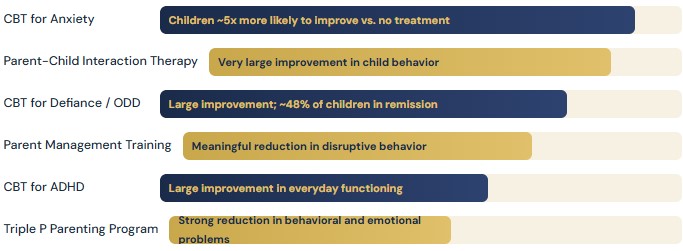
How Well Do These Treatments Actually Work?
Based on large research reviews. Longer bar = stronger evidence of real-world improvement.

Parenting-focused approaches are often just as effective as child-directed therapy. A landmark randomized trial published in the Journal of the American Academy of Child and Adolescent Psychiatry (Lebowitz et al., 2020) found that SPACE — a parent-only treatment targeting family accommodation of anxiety — produced outcomes statistically noninferior to full child-directed CBT, with no direct child-therapist contact required.

Explore all the therapy approaches we use: → Types of Therapy at Aspire Psychological Group

🔄
What is family accommodation? It’s what happens when parents adjust their behavior to reduce a child’s distress: allowing avoidance, providing excessive reassurance, and answering for them socially. Research shows this maintains and often worsens anxiety over time. Effective treatment helps parents respond differently — with warmth and support, but without accommodation.

There is also strong evidence that problems do not simply resolve on their own. A large longitudinal study (Ammerman et al., 2023) found that a substantial proportion of children with early behavioral concerns showed deteriorating trajectories over time. The 2–4 year gap between symptom onset and treatment entry is not neutral time.

Can Parents Come to Sessions?

Yes — and at Aspire, parent involvement is not just welcome, it is central to how we work.

For younger children, parents often participate directly in sessions. Many evidence-based approaches for young children are structured around parent-child interaction in the room — the parent is the vehicle for change, not just an observer. For school-age children and adolescents, we provide regular parent guidance sessions alongside the child’s work, so you always know what’s happening and how to support progress at home.

Parent-only sessions are also fully available. If your child isn’t ready to engage — or if you want to understand what you’re seeing before involving your child — we can begin entirely with you. Research on parenting-focused interventions is among the strongest in all of child mental health.

Play therapy is a powerful, developmentally appropriate approach for young children. → Learn about Play Therapy at Aspire

👨‍👩‍👧
Our approach is collaborative by design. You bring deep knowledge of your child that no clinician can replicate. Our job is to bring the clinical tools. The combination of those two things is where lasting change happens.

Is Therapy Worth It for Kids?

It’s a fair question, especially with the time, cost, and emotional investment involved. The research answer is straightforward: yes, when the right treatment is matched to the right problem.

Multiple large research reviews show CBT produces improvement rates roughly 4–5 times higher than no treatment for childhood anxiety. Parenting interventions show some of the strongest results in all of child psychology — the average treated child improves far more than children who don’t receive support. These aren’t small or theoretical differences. They’re clinically meaningful changes in children’s actual daily lives.

What therapy offers — done well — is a personalized treatment plan built on evidence, delivered in a high-touch, confidential setting where your child’s specific profile shapes every clinical decision. That’s different from a generic approach, and the difference shows in outcomes.

And the cost of waiting isn’t neutral. Research consistently shows that early support produces better outcomes than waiting for a crisis — the longer a pattern is in place, the more work it takes to shift.

What Bergen County Families Say
Verified Google Reviews & Aspire Parent Feedback
★★★★★
“My son was hesitant at first — but after the first session he actually wanted to go back.”
L.M.
Google Review
★★★★★
“We’ve seen steady, meaningful progress with our son. We feel supported every step of the way.”
H.G.
Google Review
★★★★★
“The unique ability to be truly present with my child — and with me as a parent — made all the difference.”
Y.F.
Google Review
★★★★★
“The combination of intuition and clinical knowledge is what made this work. Genuinely extraordinary.”
B.G.
Google Review

Does My Child Need Therapy — or Do I Need Parenting Support?

This is one of the most useful reframes I can offer a parent who’s on the fence. The question isn’t always “does my child need to go to therapy?” Sometimes the more accurate question is “what does our family system need right now?”

You don’t need to figure out which one you need before calling. We’ll help you decide. → Learn about Parenting Support & Education at Aspire

The answer, clinically speaking, is often: both can help, and the combination is frequently more powerful than either alone.

Many childhood challenges — anxiety, defiance, emotional outbursts, school refusal, rigid behavior — improve dramatically when parents receive the right tools and guidance alongside (or even instead of) direct child-focused treatment. This is why sophisticated, evidence-based treatment always considers the family system, not just the child in isolation.

Child Therapy vs. Parent Support — When Each Makes Sense
👧
Child therapy is typically the focus when…
The child has internalized anxiety, specific phobias, depression, OCD, trauma, or a well-defined disorder requiring skill-building
👨‍👩‍👧
Parent support is typically the focus when…
The child is young (under 8), refuses to attend, or the primary driver is family dynamics — accommodation, discipline patterns, parental stress
🤝
Both together work best when…
Behavioral or emotional problems are moderate-to-severe, have been present a while, or have taken root in family patterns — which is most cases
Combined
💡
You don’t need to figure out which one you need before calling. After an intake conversation, our team can help point you in the right direction — whether that’s child-focused work, parent support, or both.

You’ve Been Wondering Long Enough.

Reach out and we’ll help you figure out the right next step — whether that’s scheduling an intake, asking a question, or just getting a sense of whether Aspire is the right fit for your family.

Parent-only sessions available
No diagnosis required
Telehealth throughout NJ & NY
Confidential care

Aspire is a private-pay practice. Many families receive partial reimbursement through out-of-network benefits — we’re happy to walk you through how that works.

Bergen County, NJ · Rockland County, NY · Ridgewood · Franklin Lakes · Wyckoff · New City · Telehealth throughout NJ & NY

Frequently Asked Questions

Your pediatrician is an important partner, and the AAP recommends they use validated screening tools at every well-child visit starting in infancy. It’s completely reasonable to ask your pediatrician whether they’re using a tool like the Pediatric Symptom Checklist or the Strengths and Difficulties Questionnaire. If you’ve had that conversation and still feel uncertain, a consultation with a child psychologist can give you a more comprehensive clinical picture. The two approaches work best together.

Shyness is a temperament trait — taking time to warm up, but able to participate and function once comfortable. Anxiety is when fear or worry prevents participation, causes physical symptoms, and persists or grows despite reassurance. The key question is direction: is avoidance shrinking over time, or expanding? If it’s expanding — that’s worth a conversation.

Absolutely — and at Aspire, parent involvement is central to our model. For younger children, parents often participate directly. For older children and teens, we run regular parent guidance sessions in parallel. Parent-only sessions are also available when a child isn’t yet ready to engage directly. You are never just a bystander here.

The research answer is clearly yes. Multiple large studies show CBT produces improvement rates roughly 4–5 times higher than no treatment for childhood anxiety. Parenting-focused interventions show some of the strongest results in all of child psychology. Early support consistently produces better outcomes than waiting — and the longer a pattern is in place, the more work it takes to shift.

Children benefit from clinical support at any age, including toddlers. For children under 5, therapy usually looks like parent-child work — the research on these approaches for young children is some of the strongest we have. School-age children respond well to structured CBT. Adolescents benefit from both individual and family-informed approaches. Earlier is consistently better.

Getting an accurate clinical picture doesn’t create a problem — it helps you address one that already exists. Children whose struggles are identified and treated early have significantly better long-term outcomes than those who wait for a crisis. A clinical understanding, used well, is a map — not a sentence.

You have more options than you might think. Parent-only approaches like SPACE and Parent Management Training include a head-to-head trial showing outcomes equivalent to child-directed CBT, with no direct child contact required. We can often make significant progress working primarily with you while your child becomes ready to engage directly.

Aspire is an out-of-network provider. Many families with PPO or out-of-network benefits receive significant reimbursement for sessions, and we provide documentation to support your claim. Call (201) 639-4669 to ask how this works.

Weitzman C, et al. Promoting Optimal Development: Screening for Mental Health, Emotional, and Behavioral Problems. Pediatrics. 2025;156(3):e2025073172.

Walter HJ, et al. Clinical Practice Guideline for Anxiety Disorders in Children and Adolescents. J Am Acad Child Adolesc Psychiatry. 2020;59(10):1107–1124.

Hong JS, Tillman R, Luby JL. Disruptive Behavior in Preschool Children. J Pediatrics. 2015;166(3):723–30.

Jensen PS, et al. Action Signs for Identifying Children With Unmet Mental Health Needs. Pediatrics. 2011;128(5):970–9.

Iorfino F, et al. Clinical Stage Transitions in Persons Aged 12 to 25 Years. JAMA Psychiatry. 2019;76(11):1167–1175.

Lebowitz ER, et al. Parent-Based Treatment as Efficacious as CBT for Childhood Anxiety. J Am Acad Child Adolesc Psychiatry. 2020;59(3):362–372.

Helander M, et al. Efficacy of Parent Management Training. Child Psychiatry Hum Dev. 2024;55(1):164–181.

James AC, et al. CBT for Anxiety Disorders in Children. Cochrane Database Syst Rev. 2020;11:CD013162.

Wang Z, et al. CBT and Pharmacotherapy for Childhood Anxiety. JAMA Pediatrics. 2017;171(11):1049–1056.

Riise EN, et al. CBT for Externalizing Disorders in Children. Clin Psychol Rev. 2021;83:101954.

Bayer JK, et al. Risk Factors for Childhood Mental Health Symptoms. Pediatrics. 2011;128(4):e865–79.

Racine N, et al. Perinatal Risk and Protective Factors for Mental Health Disorders by Age 9. Eur Child Adolesc Psychiatry. 2025.

Ammerman RT, et al. Behavior Problems in Low-Income Young Children. JAMA Pediatrics. 2023;177(12):1306–1313.

Thomson KC, et al. Social-Emotional Functioning Profiles at School Entry. JAMA Network Open. 2019;2(1):e186694.

Singh B, et al. Physical Activity in Improving Depression and Anxiety in Children. J Am Acad Child Adolesc Psychiatry. 2025.

Conroy K, et al. School-Based Accommodations and Supports for Anxious Youth. J Clin Child Adolesc Psychol. 2022;51(4):419–427.

Li N, et al. Effects of Triple P on Behavioral Problems of Children. Front Psychol. 2021;12:709851.

The information in this article is for educational purposes only and does not constitute medical or psychological advice, diagnosis, or treatment. If you have concerns about your child’s mental health, please consult a licensed mental health professional. In a mental health emergency, call 988 or go to your nearest emergency room.

Recent Blog

Free Tools & Tips To Help
Your Child Thrive.

Share this blog

Dr. Aryeh Berlin, PsyD

Dr. Aryeh Berlin is a New Jersey licensed clinical psychologist and founder of Aspire Psychological Group. Dr. Berlin has vast clinical training experiences including a residential adolescent addiction treatment center in Israel, community mental health centers, and youth detention centers. Dr. Berlin has lectured on parenting children with emotional and behavioral difficulties, child development, helping children with school-related challenges and trauma. Audiences included attorneys, mental health professionals, parents, and educators.