

It’s not just talking. Here’s what effective, research-backed treatment looks like from the inside.
A note before we begin
If you’re reading this, your child is probably struggling with something — and you’re struggling right alongside them. Struggling to understand what’s really going on. Struggling to figure out how to help, what to say, what not to say. Wondering whether the things you’ve tried are making it better or worse. And underneath all of it, a question you may not have said out loud: will anything actually help?
You’ve probably also wondered whether therapy actually does anything — or whether it’s just talking. Whether a stranger in an office can possibly understand what your family is going through. Those are fair questions. This article is the honest answer.

Parents often ask me: “What are you doing during the sessions with my child?” It’s a fair question — and an important one. Not all therapy is the same, and the difference between a productive session and an hour of unstructured conversation can make a significant difference in your child’s progress.
Research is now quite clear on this: the most effective child therapy sessions are structured, skills-based, and purposeful. They look less like a casual chat and more like a focused lesson in how to understand emotions, challenge unhelpful thinking patterns, and face fears — all within a warm, trusting relationship. Here’s what that actually looks like in practice.

It Starts Before Your Child Walks In: The Parent Check-In
High-quality child therapy doesn’t begin the moment your child sits down. In evidence-based practice, sessions typically open with a brief parent check-in, often around 15 minutes, where the therapist touches base with you about the week. How were the homework exercises from the last session? Were there any difficult moments? Any wins worth celebrating?
This isn’t small talk. Research consistently links parent involvement to better outcomes in many evidence-based child therapies, particularly when it comes to sustaining gains over time. Therapists who keep parents in the loop — reviewing progress, teaching you how to support skill practice at home, and coaching you on responding to your child’s anxiety or emotional struggles tend to produce stronger, more lasting results than those who treat the hour as entirely private.
“The most effective child therapy doesn’t happen only in the therapy room. It happens in the car ride home, at the dinner table, and in the moments when your child faces something hard with your support.”
This also means you won’t feel sidelined. One of the most common fears parents have is that therapy becomes a black box, your child goes in, something happens, and you’re left in the hallway wondering. In evidence-based treatment, that’s explicitly not how it works. You are a core part of the treatment team.
Want to understand your role more deeply? Learn more about how we support parents alongside their children. Learn More: Family Therapy
The Therapist’s Role
All Within the Session
- Teaches your child new skills for managing thoughts and emotions
- Guides exposure work at a safe, child-led pace
- Monitors progress and adjusts the approach
- Builds the trust and relationship that makes the work possible
- Debriefs you at the end of every session what was worked on and how to support it at home
Your Role as a Parent
Between Sessions, at Home
- Reinforce the skills your child is learning — the session debrief will tell you exactly how
- Respond to your child’s anxiety in ways that build confidence, not avoidance
- Prompt and celebrate between-session practice
- Bring observations from home, school, and social life to the next session check-in
- Stay curious and avoid rescuing from discomfort too quickly
Anatomy of a 45–50 Minute Session
What happens, in what order — in a typical evidence-based child therapy session
Warm-Up & Mood Check
A brief connection — how is the child feeling today? A simple feelings thermometer or check-in rating helps the therapist calibrate the session and gives the child language for their emotional state.
Homework Review
Reviewing practice tasks from the previous week — what the child tried, what happened, and what they learned. Effort and attempts are celebrated, not just perfect completion.
Active Skill Work — The Core
The heart of the session. New skills are introduced, practiced through role-play, and applied to the child’s real situations. For anxious children, this often includes exposure work. Cognitive techniques, coping strategies, and behavioral experiments are all fair game.
Wrap-Up & Homework Assignment
Consolidating what was learned, setting a specific between-session practice task, and ending on something positive — praise for effort, a moment of celebration, or a brief grounding exercise.
Parent Debrief — Still Part of the Session
The child rejoins the parent for a brief check-in — all within the session time. The therapist shares what was worked on, how the child did, and exactly how you can support this week’s practice at home. You leave with a clear picture and a concrete role.
What Happens in the Session Itself
And the work continues when your child joins the session. The research is specific about what this time should look like: sessions built around active therapeutic techniques — not general conversation — are what drive change.
Studies analyzing the content of psychotherapy sessions have found that the proportion of time spent on active skill-building, cognitive techniques, and behavioral strategies is directly associated with symptom improvement. Conversely, sessions that spend too much time on open-ended chatting or general empathy without active intervention tend to be less effective.

What Session Content Actually Drives Improvement
Based on deep-learning analysis of ~90,000 hours of CBT sessions (JAMA Psychiatry, 2020)
*Bar widths represent relative association strength, not exact effect sizes. Adapted from Ewbank et al., JAMA Psychiatry 2020.
So what does active, skills-based child therapy actually include?
Core Components of an Effective CBT Session for Children
- Identifying the connection between thoughts, feelings, and physical sensations
- Recognizing unhelpful thinking patterns (like catastrophizing or mind-reading)
- Practicing cognitive restructuring — challenging those thoughts and building more balanced ones
- Exposure exercises: gradually and safely facing feared situations, in imagination or in real life
- Learning and practicing relaxation and coping strategies
- Reviewing and refining homework from the previous week
- Assigning new practice tasks to bridge the session to real life
Sessions typically involve modeling, role-play, and contingent reinforcement — meaning the therapist actively demonstrates skills, practices scenarios with the child, and genuinely celebrates effort and progress. This is engaging, hands-on work, not passive listening.
The CBT Triangle: How Thoughts, Feelings, and Behaviors Connect
One of the first things a child learns in CBT is something deceptively simple: thoughts, feelings, and behaviors are connected. Change one, and you change the others. This framework — sometimes called the cognitive triangle — sits at the center of almost everything that happens in session.
The Cognitive Triangle
The foundation of CBT — how thoughts, feelings, and behaviors influence each other
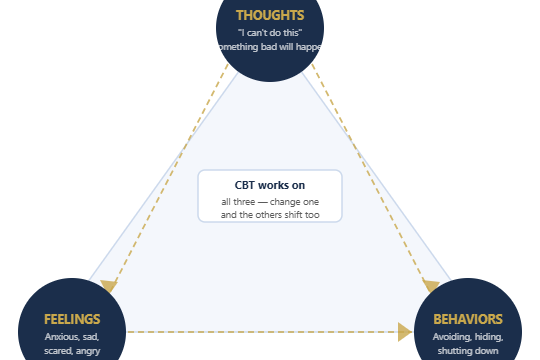
When a child learns to challenge an anxious thought, their feelings shift — and so does what they do next.
For Anxious Children: Exposure Is the Core
If your child is being seen for anxiety — whether it’s separation anxiety, social anxiety, OCD, phobias, or generalized worry — exposure work will likely be a central part of treatment. This is often the component parents feel most uncertain about, so it’s worth explaining clearly.
Exposure therapy doesn’t mean throwing your child into their worst fear all at once. It means building a hierarchy — a ladder of increasingly challenging situations — and working through it systematically, one rung at a time. The therapist begins with situations that provoke mild anxiety, helps the child tolerate and move through that discomfort, and gradually works toward more challenging scenarios. Both imaginal (vividly picturing the situation) and in-vivo (real-life practice) exposures are used.
The Exposure Ladder — An Example for Social Anxiety
Starting easy and climbing gradually — the child leads the pace, co-creating every step
This process is paired with cognitive work: helping your child identify the catastrophic predictions their mind makes (“Something terrible will happen”) and testing those predictions against what actually occurs. Over time, the child’s brain learns that the feared outcome either doesn’t happen, or that they can handle it. That’s where lasting change comes from.
For a deeper look at how anxiety treatment works for children, read our parents’ guide: A Parent’s Guide to Child Anxiety Therapy.
When Trauma Is Part of the Picture: TF-CBT
For children and adolescents who have experienced trauma, the gold-standard treatment is Trauma-Focused Cognitive Behavioral Therapy (TF-CBT). This is a structured, phase-based approach with the strongest evidence base for trauma-related symptoms across the full pediatric age range.
Stabilization
Building safety and coping skills — psychoeducation about trauma responses, relaxation techniques, emotional regulation, and beginning to understand the connection between thoughts, feelings, and behaviors.
Processing
Creating a trauma narrative with the therapist’s guidance — gradually telling the story of what happened in a safe, supported way, and working through the thoughts and beliefs attached to it.
Consolidation
Integrating the experience, strengthening the child’s sense of resilience and safety, and planning for the future. Parents are closely involved throughout all three phases.
Across research studies, TF-CBT consistently demonstrates moderate-to-large treatment effects for trauma-exposed children and adolescents, making it one of the most well-validated interventions available.
What About Play Therapy?
Play therapy is probably the approach most people associate with child mental health treatment, and for good reason — play is a child’s natural language. But it’s worth understanding what the research says and when it fits.
Child-centered play therapy, in which the therapist creates a warm, accepting space for the child to express themselves freely through play, shows small-to-moderate effects in the research literature — particularly for younger children or those processing difficult experiences. Psychodynamic play therapy, which uses play to explore deeper emotional themes and the child-therapist relationship, has shown some early promise in specific populations, including children who have experienced abuse and toddlers of depressed mothers — though it’s worth noting this evidence comes from a small number of studies, and the research base here is still developing.
Play-Based vs. Structured Approaches: When Each Fits Best
Both have a place — the question is matching the approach to the child and the goal
 Play-Based Therapy Play-Based Therapy |  Structured CBT Structured CBT | |
|---|---|---|
| Best for age | Young children (3–7), or any child who struggles to verbalize | School age through adolescence (6+) |
| Primary goal | Express, process, and feel understood through symbolic play | Learn specific skills to change thinking and behavior patterns |
| Evidence strength | Small-to-moderate; strongest for younger / trauma-exposed children | Strong-to-very-strong; especially for anxiety, OCD, depression |
| Role of play in session | Play is the primary therapeutic vehicle | Play can be woven in to build engagement and surface material |
| For externalizing behavior | Less consistent evidence as a standalone | Best combined with parent behavior management training |
Play absolutely has a place in the therapy room — and how it shows up often depends on the child’s age and developmental needs. With younger children, especially, a therapist might play with a sand tray, work on a puzzle together, or play a board game during conversation. This isn’t filler time. For many children, side-by-side play lowers their guard in ways that direct questioning never could. Difficulties that might not surface in a face-to-face talk often emerge naturally in the middle of a game — and that creates a genuine, in-the-moment opportunity to notice, name, and process what’s coming up. The most effective therapists know when to use play therapeutically in this way, and when to shift toward more structured, skills-based work. Often it’s both, woven together across the same session.
The Homework That Makes It Stick
One of the most consistent markers of high-quality child therapy is the assignment of specific, structured practice between sessions. The research generally supports between-session work as important for skill consolidation — though interestingly, the evidence suggests that a child’s engagement and effort during the session itself may matter as much as whether the homework gets completed perfectly at home. The takeaway: between-session practice matters, and so does how actively your child is working inside the room.
Good homework isn’t busy work. It might look like a child practicing a brief relaxation exercise before bed, completing a thought-challenging worksheet after a difficult situation at school, or deliberately engaging in a small exposure task — approaching a feared situation rather than avoiding it. Parents play a critical role here: the session debrief gives you everything you need to coach, prompt, and celebrate effort at home between sessions — no check-ins required.
What Effective Therapy Looks Like Over Time
Evidence-based child therapy is typically structured around a clear protocol, with consistent session formats and an arc of skill-building that unfolds across weeks. A common format is around 16 weekly sessions of 45–50 minutes each, though the right fit varies significantly by child, diagnosis, and severity — and research increasingly supports that brief, intensive, or concentrated formats can be comparably effective for some children. The number of sessions isn’t what defines quality; it’s whether treatment is structured, goal-directed, and adjusted based on how your child is actually doing.
Progress in good therapy is also measurable. Your child’s therapist should be tracking symptoms over time — through parent and child ratings, structured measures, or direct clinical assessment — and using that data to inform what comes next. If something isn’t working, the approach adjusts. Effective therapy is not a fixed routine applied the same way to every child; it’s a responsive, data-informed process.
Before Effective Therapy
What families often describe
Dread on Sunday nights before a school week
Constant reassurance-seeking that never really helps
Avoidance of anything uncertain or uncomfortable
Meltdowns that leave everyone drained and confused
Parents walking on eggshells to prevent the next eruption
A child who feels different, broken, or alone
A parent who feels helpless — or like they’re the problem
After Evidence-Based Treatment
What families report noticing
A child who can name what they’re feeling — and do something about it
Tolerating uncertainty without falling apart
Trying things that used to feel impossible
Asking for help in words instead of behaviors
Parents who feel equipped, not just hopeful
A child who starts to trust themselves again
Home feeling calmer — not because problems vanished, but because everyone has better tools
Signs a Child Therapy Approach May Not Be Evidence-Based
- Sessions consist primarily of open-ended conversation with no structured skill-building
- No homework or between-session practice is assigned
- Parents are consistently excluded from the process
- There is no clear treatment plan, measurable goals, or progress monitoring
- The approach hasn’t changed after many months with little visible progress
- The therapist cannot name the specific evidence-based model guiding treatment
Have questions about what to look for in a child therapist? Our FAQ page has answers. Learn More: Frequently Asked Questions
The Relationship Still Matters — A Lot
None of this means therapy is a cold, mechanical process of running through worksheets. The therapeutic relationship, the trust, warmth, and sense of safety your child feels with their therapist, is the foundation on which all of this skill-building rests. A child who doesn’t feel seen, safe, and respected by their therapist will not engage with the work.
What distinguishes the best child therapists isn’t just their command of the techniques — it’s their ability to build genuine connection while maintaining a clear clinical direction. Research on session content confirms this: therapeutic praise, forward planning, and a genuine sense of momentum toward change are among the strongest predictors of improvement. Those aren’t just techniques; they’re expressions of a warm, purposeful therapeutic relationship.
Effective child therapy is structured, but it doesn’t feel rigid to the child. It feels like someone who really gets them and has a clear, hopeful plan to help them get unstuck. And for you, as a parent, it should feel like finally having a partner who understands what you’re navigating and knows exactly what to do about it.

You Don’t Have to Figure This Out Alone
If what you’ve read here reflects what your family is going through, the next step is a conversation — no pressure, no commitment. We’ll listen, ask the right questions, and tell you honestly whether we think we can help.
Serving families in Bergen County, NJ & Rockland County, NY · In-person & telehealth · 201-639-4669


