

If mornings have turned into a battle, you are not alone, and there is a clear, research-backed way through it that does not require choosing between comfort and pushing your child too hard.
If your child is already complaining of stomachaches, refusing to shop for school supplies, asking to switch classes, or saying “I can’t do this,” you are not alone. Many children feel a real surge of anxiety before a new school year begins. The question parents ask most often is: should I comfort my child, or push them through the fear? The honest answer is both. Knowing how to balance genuine support with steady encouragement is what actually makes the difference, and that is what this guide walks through.
Should I let my anxious child avoid school?
Short answer: No. Avoidance usually makes anxiety stronger over time. The goal is not to force a child through with no support, but to help them gradually face the feared situation while feeling understood.
Quick Summary
- The most effective transitions combine several strategies at once, not a single fix: validating feelings, teaching real coping skills, practicing gradually, and coordinating with the school.
- Comfort and avoidance are not the same thing. Supporting a child through anxiety looks different from removing the source of it, and the research is clear about which approach holds up over time.
- Graduated practice is the most consistently supported tool. Small, doable steps toward the feared situation, repeated and built on, outperform either forcing a full return all at once or avoiding it entirely.
- The school is a partner, not a bystander. Teacher communication and thoughtfully designed supports change outcomes, but only when those supports encourage participation rather than excuse a child from it.
- Starting the process before the first day helps. It is not the whole plan, but beginning earlier rather than later gives every other strategy below more room to actually work.
Understanding What Is Actually Driving the Anxiety
Before choosing a strategy, it helps to understand what is underneath the resistance, because “anxious about school” can mean several different things. Some children are worried about being separated from a parent. Others dread a specific social situation, like presenting in class or eating in the lunch room. Some are worried about whether classmates will like them, and some are worried about having a teacher they perceive as “mean,” or about academic performance more broadly. Others are not describing fear at all, but showing up with stomachaches or headaches that appear on school mornings and disappear on weekends.
Researchers describe school-related anxiety as falling into a small number of underlying patterns: fear of the school setting in general, fear of a specific social or evaluative situation, a pull toward staying close to a parent, or a pull toward something more rewarding happening at home. Identifying which of these is closest to your child’s experience changes which strategies below will matter most. A child anxious about separation needs a different kind of support than a child anxious about being called on in class.
Five Pillars of an Effective, Supportive Transition
Across the research on childhood anxiety and school transitions, the approaches that hold up consistently share a few common elements. None of them work well in isolation. Together, they form a genuinely supportive plan.
1. Validate the Feeling
Naming and acknowledging anxiety, without dismissing it or over-reassuring, helps a child feel understood and reduces the urge to escalate distress to be taken seriously.
2. Teach Real Coping Skills
Simple tools such as noticing physical sensations, slow breathing, and identifying and challenging catastrophic thoughts give a child something concrete to use in the moment. It also helps to teach that some distress can simply be tolerated and ridden out rather than immediately fixed, a skill drawn from approaches like ACT and DBT, so anxiety does not always have to be eliminated before a child can move forward.
3. Practice Gradually
Structured, stepwise exposure to the feared situation, building from easy to hard, is the piece of treatment most consistently linked to real improvement.
4. Adjust the Home Response
How a family responds to distress, whether it reinforces avoidance or gently encourages approach, shapes whether anxiety grows or shrinks over time.
5. Coordinate With the School
A shared plan between home and school, including a point person and clear expectations, keeps the approach consistent instead of working against itself.
6. Stay Steady Yourselves
A child picks up on a parent’s own worry. Staying calm and matter-of-fact, even when a morning is hard, models the steadiness a child is still learning to build for themselves.
Validate Without Accommodating
This is the piece parents most often ask about, because it can feel contradictory. Supporting a child through anxiety means taking their distress seriously. It does not mean removing the source of the distress whenever possible.
Validating is not the same as agreeing that the situation is actually dangerous or that avoidance is the right answer. It means understanding, and communicating to your child, that this is genuinely difficult for them, from their perspective, in this moment, even if you would not personally find it hard or do not believe the fear is warranted. A child who feels understood is generally more willing to move forward than a child who feels dismissed or rushed past.
Family accommodation refers to the changes caregivers make to relieve a child’s anxiety, things like an open-ended pass to leave class, skipping a presentation entirely, or being allowed to stay home rather than push through a hard morning. These changes bring short-term relief and, in the long run, teach a child that the situation is something to be escaped rather than something they can handle.
Remission of Anxiety: Parent-Focused Treatment vs. No Treatment
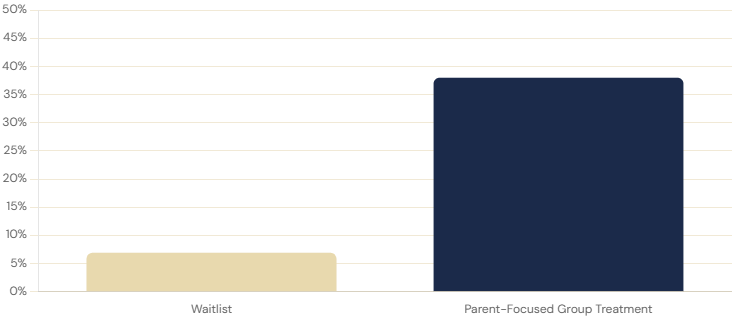
Approaches that work directly with the parent’s response, teaching families to reduce accommodation while still offering warmth and support, have shown real, measurable benefit. In practice, this looks like acknowledging the feeling out loud, staying calm and steady, and still expecting the child to follow through, whether that is attending the full day, walking into the classroom, or completing the harder step of the plan.
| Instead of… | Try… |
|---|---|
| Letting your child stay home whenever mornings are hard | Naming the feeling, then following the agreed plan for getting to school anyway |
| Excusing your child from presentations entirely | A stepped version: presenting to the teacher alone, then a small group, then the class |
| Doing hard tasks for your child | Coaching your child to do it themselves, with support nearby |
| Agreeing to pick your child up early, or letting them call you from the nurse’s office, whenever they feel anxious | A time-limited check-in with the nurse or counselor, followed by a return to class, with pickup reserved for genuine illness |
Should I force my child to go to school?
Short answer: Not without support, and not all at once. “Forcing” without a plan tends to escalate distress, while avoiding entirely reinforces the fear. The middle path, expecting attendance while actively supporting your child through it, is what the research consistently favors.
What to say when your child says…
“I can’t go. I’m too nervous.”
“I believe you. This feels really hard. And I also believe you can handle this. Let’s take the next small step together.”
If your child’s anxiety is interfering with school attendance, friendships, or daily life, professional support can help. Aspire Psychological Group works with children and families throughout Bergen County.
Practicing With Graduated Steps
Of everything covered in this article, graduated practice has the most consistent research support. The idea is straightforward: build a list of school-related situations from least to most difficult, and move through them one at a time, only advancing once the current step feels manageable.
- Talk about it. Low-pressure conversation about what feels hard, without needing to solve everything in one sitting.
- See it. Look at photos of the classroom, drive by the building, or walk past it together.
- Enter it. Visit the building itself, ideally with a friendly staff member present.
- Meet the people. A short conversation with the teacher, counselor, or another familiar adult.
- Rehearse the routine. A full mock morning on the actual schedule, ending at drop-off.
- Do the real thing. The actual day, ideally feeling like the next small step rather than a leap.
Two details make this approach work: more total time spent on exposure, and a willingness to move to harder steps rather than staying comfortable, both predict a better outcome. A hierarchy rushed through in a day or two rarely builds the same confidence as one worked through steadily over time, which is one of the clearest reasons to begin before the pressure of the first day arrives.
What to say when your child says…
“What if nobody wants to sit with me at lunch?”
“That’s a really normal worry. Let’s think of one thing you could say or do at lunch tomorrow, just one small thing, and we can practice it together tonight.”
Partnering With the School
Home strategies work best when the school is pulling in the same direction. Teacher communication, a designated point person, and a written plan, sometimes formalized as a 504 plan, all give a child consistency between home and the classroom.
of surveyed school staff used at least one support later rated as avoidance-promoting rather than helpful
Most school-based supports come from a genuine desire to help, but many unintentionally work against the goal. Blanket exemptions, unrestricted passes, and permission to skip hard moments entirely tend to reinforce the exact avoidance a family is trying to reduce.
What the Research Shows
The combination of strategies above is not a guess. It reflects a fairly consistent pattern across the research on childhood anxiety and school-related avoidance.
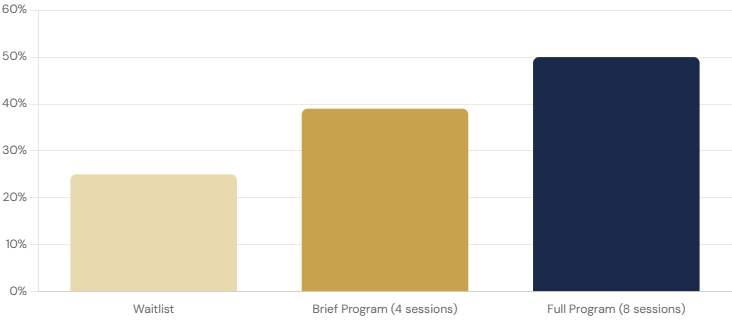
Structured, Full Treatment Outperforms a Partial Version
Whatever the format, a fuller, more complete approach reliably outperforms a shortened one. A trial comparing a complete guided parent program against an abbreviated version found the complete version produced meaningfully higher recovery, while the abbreviated version did not separate from doing nothing.
Recovery Rate by Treatment Completeness
Dedicated Transition Support Helps When It Starts Early
Programs built specifically around school transitions have shown reduced transition-related worry and increased coping confidence compared with children who did not receive them. Notably, the research specifically points to starting this kind of support well before the point of transition as more effective than concentrating it right at the moment of change.
Technology Can Extend Support, With Real Limits
For families who cannot access in-person therapy easily, therapist-supported digital programs have shown genuine benefit for clinician- and caregiver-rated outcomes.
Remission of Primary Anxiety Disorder: Digital CBT vs. Control
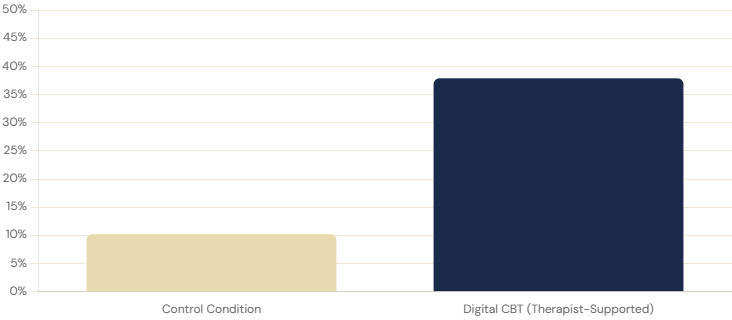
The limitation worth knowing: youth-reported anxiety symptoms did not reliably improve in these programs even when caregiver and clinician ratings did, and fully self-guided programs with no therapist involvement performed the weakest of all. Digital support works best as one part of a broader plan, not a replacement for the other pillars covered here.
— L.M., Aspire Psychological Group client
When to Bring in Extra Support
Most families can put much of this plan into practice on their own. Some situations call for professional guidance so the approach stays structured and does not stall.
| Situation | Why It Matters |
|---|---|
| A history of school refusal or significant absences | An established pattern is harder to shift without a structured plan |
| Frequent physical complaints tied to school mornings | Often the clearest early sign of anxiety rather than a separate medical issue |
| A parent managing their own significant anxiety | Associated with a slower response to a home-based approach |
| The plan stalls for more than a week or two | Often a sign the current step is too large or another issue needs attention |
| Panic-level distress at any point | Warrants a professional assessment rather than continuing alone |
If any of these apply to your family, this is a good point to bring in professional support rather than continuing to manage it alone. Aspire Psychological Group works with children and families throughout Bergen County.
When Bergen County Parents Should Seek Help for School Anxiety
At Aspire Psychological Group in Upper Saddle River, NJ, we work with children and families throughout Bergen County who struggle with school anxiety, school refusal, perfectionism, and difficult transitions. Families reach out to us from Ridgewood, Ramsey, Mahwah, Franklin Lakes, Montvale, Saddle River, and Wyckoff, along with communities across Rockland County, New York, often around the same point in the summer when back-to-school worry starts to show up at home.
If your family is local to any of these communities and a home-based plan is not gaining traction, or your child has a history of school refusal, a consultation with a clinician who specializes in pediatric anxiety is a reasonable next step, rather than waiting to see whether the new school year resolves it on its own.
About Aspire Psychological Group
Aspire Psychological Group is a private psychology practice in Upper Saddle River, New Jersey, specializing in evidence-based treatment for childhood anxiety, OCD, school refusal, ADHD-related emotional challenges, and parenting support. The practice serves Bergen County, New Jersey and Rockland County, New York, with telehealth available statewide across both states. Treatment approaches include CBT, exposure and response prevention, ACT, SPACE, parent management training, and parent-child interaction therapy.
A supportive transition is a plan, not just good intentions.
Aspire Psychological Group helps families build the coping skills, graduated practice, and school coordination that make the transition back to school genuinely manageable.
Selected Sources
- Kearney CA, Silverman WK. A Preliminary Analysis of a Functional Model of Assessment and Treatment for School Refusal Behavior. Behavior Modification, 1990.
- Yin B, et al. Efficacy and Acceptability of Parent-Only Group Cognitive Behavioral Intervention for Treatment of Anxiety Disorder in Children and Adolescents. BMC Psychiatry, 2021.
- Thirlwall K, et al. Treatment of Child Anxiety Disorders via Guided Parent-Delivered CBT. The British Journal of Psychiatry, 2013.
- Bagnall CL, et al. A Mixed-Methods Evaluation of a Longitudinal Primary-Secondary School Transitions Support Intervention. Frontiers in Psychology, 2023.
- Conroy K, et al. School-Based Accommodations and Supports for Anxious Youth. Journal of Clinical Child and Adolescent Psychology, 2020.
- Walter HJ, et al. Clinical Practice Guideline for the Assessment and Treatment of Children and Adolescents With Anxiety Disorders. Journal of the American Academy of Child and Adolescent Psychiatry, 2020.
- James AC, et al. Cognitive Behavioural Therapy for Anxiety Disorders in Children and Adolescents. The Cochrane Database of Systematic Reviews, 2020.


