
The anxiety that keeps growing. The meltdowns that feel bigger than they should. The school refusal. The sadness. The social struggles. If you’re asking whether this is a phase or something more — you’re already paying attention the way thoughtful parents do.
 Dr. Aryeh Berlin, PsyD
 10 min read
 Updated 2026
 Evidence-Based
 Trusted by Bergen County Families
You’re not an alarmist. You’re a parent paying attention. And the question you keep circling back to — does my child actually need therapy, or is this just a phase? — is an important question.
It’s also one that most parents are left to answer alone. At Aspire Psychological Group, we help families throughout Bergen County, NJ and Rockland County, NY — including Ridgewood, Franklin Lakes, Wyckoff, Ramsey, Upper Saddle River, New City, and surrounding communities — answer this question every day, with clarity, compassion, and evidence-based expertise.
You don’t need a crisis to seek help. You only need a concern. Here’s what the research actually says about when to act, and when to watch and wait.
Wondering If Aspire Is the Right Fit for Your Family?
Reach out to our intake team — it’s a low-key way to share what’s going on, ask questions about how we work, and see if we’d be a good match. No pressure, no commitment.
Aspire is a private-pay practice. Many families receive partial reimbursement through out-of-network benefits — we’re happy to walk you through how that works.
The Problem Is Bigger Than Most Parents Realize
Here’s what stops parents from acting: they assume that if the problem were serious, they’d already know. The data tells a different story.
 What the Research Tells Us About Childhood Mental Health
Almost half of children with diagnosable anxiety or behavioral problems never get help. Not because their parents don’t care — but because no one gave them a clear framework for when to act. That’s what this article is for.
The #1 Thing That Separates Normal Struggle From a Real Problem
Every child worries. Every child melts down. Every child has hard days. So how do you know when it crosses a line?
According to the American Academy of Pediatrics’ 2025 Clinical Report and the American Academy of Child and Adolescent Psychiatry guidelines, the answer comes down to one concept: functional impairment.
The line between normal childhood difficulties and problems requiring therapy is not the presence of symptoms — it’s whether those symptoms are getting in the way of your child’s life.
Clinicians assess impairment across four specific domains. If your child’s struggles are meaningfully affecting even one, that’s a signal worth taking seriously.
 School Performance
 Social Interactions
 Family Engagement
 Daily Living
Normal Behavior vs. a Real Warning Sign
A landmark longitudinal study (Hong et al., 2015) followed 273 preschoolers to map exactly which behaviors are developmentally normal and which predict lasting problems:
| Behavior |  Typically Developmental Typically Developmental |  Marker of Concern Marker of Concern |
|---|---|---|
| Tantrums / Anger | Occasional, low-intensity; resolves with comfort | Extreme, prolonged, unpredictable; frequent and beyond context |
| Defiance | Arguing, testing limits — especially ages 2–4 and adolescence | High-intensity, pervasive, across settings, not responsive to parenting |
| Worry / Fear | Age-specific fears that pass; stranger anxiety, dark, social concerns | Avoidance, excessive reassurance-seeking, physical complaints tied to anxiety |
| Sadness | Brief sadness after disappointment or change | Persistent (>2 weeks), withdrawal, hopelessness, loss of interest |
| Aggression | Low-intensity; typical toddler boundary-testing | Any aggression toward people or animals; high-intensity destruction of property |
| Peer Problems | Occasional conflict, normal social navigation | Persistent difficulty; high-intensity peer problems predict lasting issues |
It’s not the presence of these behaviors, but their intensity, frequency, and persistence that distinguish normal development from something warranting a closer look.
10 Research-Backed Signs It May Be Time to Get Help
Drawing on Jensen et al.’s (2011) empirically derived “action signs” — validated against epidemiologic data from over 6,000 children — here are the ten signals most reliably indicating unmet mental health needs:



Is My Child Anxious or Just Shy?
This is one of the most common questions I hear — and it’s a meaningful one, because shyness and anxiety can look nearly identical from the outside.
Shyness is a temperament trait. A shy child takes longer to warm up, but once they do, they can participate and function well. Shyness alone doesn’t cause significant impairment and doesn’t require treatment.
Anxiety is different in what it does over time. The AACAP guideline (Walter et al., 2020) defines clinically significant anxiety as symptoms that cause meaningful distress or functional impairment — and critically, that grow rather than diminish with exposure.
Not sure if it’s anxiety? Our intake team can help you figure it out. → Childhood Anxiety — Aspire Psychological Group

If you’re noticing avoidance that’s growing, physical symptoms that recur, or distress that feels out of proportion — that’s worth a professional conversation, regardless of what you call it.
Seeing Any of These Signs in Your Child?
Reach out to our intake team. We’ll answer your questions about how we work, who we serve, and whether Aspire might be a good fit for your family.
Aspire is a private-pay practice. Many families receive partial reimbursement through out-of-network benefits — we’re happy to walk you through how that works.
What Raises — or Lowers — Your Child’s Risk
Not all children are equally vulnerable. Research has identified specific factors that lower the threshold for concern — when these are present, even mild symptoms warrant earlier action.


Matching the Right Level of Help to the Right Problem
Not every child needs the same intensity of intervention. A JAMA Psychiatry staging model (Iorfino et al., 2019), originally developed for adolescents and young adults and applied here conceptually across ages, maps this clearly — match the intensity of support to the severity of the problem:

- Symptoms are mild, with no meaningful functional impairment
- Behavior is tied to a specific, temporary stressor
- Child continues to function in school, friendships, and family normally
- Age-normative behaviors that fit developmental expectations

- Symptoms have lasted a few weeks without improvement
- Functioning is impaired in school, friendships, family, or daily routines
- Behavior is significantly more intense than same-age peers
- Your gut has been telling you something is wrong for a while
- Multiple risk factors are present
Why Early Therapy Works — The Evidence
The treatments we have for childhood anxiety, behavioral problems, and emotional difficulties are genuinely effective. This is one of the best-supported bodies of evidence in all of psychology.
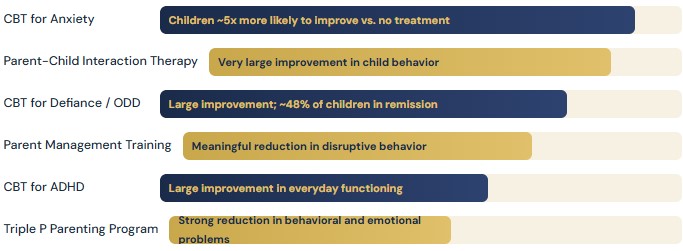
Parenting-focused approaches are often just as effective as child-directed therapy. A landmark randomized trial published in the Journal of the American Academy of Child and Adolescent Psychiatry (Lebowitz et al., 2020) found that SPACE — a parent-only treatment targeting family accommodation of anxiety — produced outcomes statistically noninferior to full child-directed CBT, with no direct child-therapist contact required.
Explore all the therapy approaches we use: → Types of Therapy at Aspire Psychological Group

There is also strong evidence that problems do not simply resolve on their own. A large longitudinal study (Ammerman et al., 2023) found that a substantial proportion of children with early behavioral concerns showed deteriorating trajectories over time. The 2–4 year gap between symptom onset and treatment entry is not neutral time.
Can Parents Come to Sessions?
Yes — and at Aspire, parent involvement is not just welcome, it is central to how we work.
For younger children, parents often participate directly in sessions. Many evidence-based approaches for young children are structured around parent-child interaction in the room — the parent is the vehicle for change, not just an observer. For school-age children and adolescents, we provide regular parent guidance sessions alongside the child’s work, so you always know what’s happening and how to support progress at home.
Parent-only sessions are also fully available. If your child isn’t ready to engage — or if you want to understand what you’re seeing before involving your child — we can begin entirely with you. Research on parenting-focused interventions is among the strongest in all of child mental health.
Play therapy is a powerful, developmentally appropriate approach for young children. → Learn about Play Therapy at Aspire

Is Therapy Worth It for Kids?
It’s a fair question, especially with the time, cost, and emotional investment involved. The research answer is straightforward: yes, when the right treatment is matched to the right problem.
Multiple large research reviews show CBT produces improvement rates roughly 4–5 times higher than no treatment for childhood anxiety. Parenting interventions show some of the strongest results in all of child psychology — the average treated child improves far more than children who don’t receive support. These aren’t small or theoretical differences. They’re clinically meaningful changes in children’s actual daily lives.
What therapy offers — done well — is a personalized treatment plan built on evidence, delivered in a high-touch, confidential setting where your child’s specific profile shapes every clinical decision. That’s different from a generic approach, and the difference shows in outcomes.
And the cost of waiting isn’t neutral. Research consistently shows that early support produces better outcomes than waiting for a crisis — the longer a pattern is in place, the more work it takes to shift.
Does My Child Need Therapy — or Do I Need Parenting Support?
This is one of the most useful reframes I can offer a parent who’s on the fence. The question isn’t always “does my child need to go to therapy?” Sometimes the more accurate question is “what does our family system need right now?”
You don’t need to figure out which one you need before calling. We’ll help you decide. → Learn about Parenting Support & Education at Aspire
The answer, clinically speaking, is often: both can help, and the combination is frequently more powerful than either alone.
Many childhood challenges — anxiety, defiance, emotional outbursts, school refusal, rigid behavior — improve dramatically when parents receive the right tools and guidance alongside (or even instead of) direct child-focused treatment. This is why sophisticated, evidence-based treatment always considers the family system, not just the child in isolation.


Why Families Choose Aspire Psychological Group
Aspire is not a general therapy practice that also sees children. We are a child and adolescent specialty practice — every clinician, every protocol, and every conversation is built around the specific developmental and emotional needs of young people and their families.
Serving families in Ridgewood, Glen Rock, Franklin Lakes, Wyckoff, Upper Saddle River, Woodcliff Lake, Ho-Ho-Kus, Saddle River, Oradell, Park Ridge, Englewood Cliffs, Teaneck, Bergenfield, West Milford and throughout Bergen County, NJ — plus Spring Valley, Chestnut Ridge, Montebello, Suffern, New City and throughout Rockland County, NY. Telehealth available throughout New Jersey and New York.


You’ve Been Wondering Long Enough.
Reach out and we’ll help you figure out the right next step — whether that’s scheduling an intake, asking a question, or just getting a sense of whether Aspire is the right fit for your family.
Aspire is a private-pay practice. Many families receive partial reimbursement through out-of-network benefits — we’re happy to walk you through how that works.
Bergen County, NJ · Rockland County, NY · Ridgewood · Franklin Lakes · Wyckoff · New City · Telehealth throughout NJ & NY


