

The teacher says everything's fine. Then your child walks in at 3:30 and the whole house feels it. There's a reason this happens, and it's probably not the one you're worried about.
01Does This Sound Familiar?
It usually starts within minutes. The backpack hits the floor, and suddenly the snack is wrong, the little brother is too loud, or the socks feel weird. Sometimes it's tears. Sometimes it's a slammed door. With teenagers it's often just a tone, a sharpness you don't hear from them on a Sunday.
Then you talk to the teacher and hear that your child is polite, focused, a pleasure to have in class. Nobody at school sees what you see at home.
I spent 11 years as a school counseling director, so I've watched this from both sides of the school day. Parents often come into my office wondering if they're the problem. Usually they aren't. More often, their child is genuinely struggling with emotions, behavior, or both, and is working hard to keep a lid on it all day. At school, losing it has real consequences: getting in trouble, being embarrassed in front of classmates, getting teased or made fun of. So they hold it in. Think of a seltzer bottle that gets shaken a little more with every class, every hallway, every hard moment. By the end of the day the pressure has built up, and once they're home, where those consequences are gone, the lid comes off. That doesn't mean you just ride it out. It's a pattern worth understanding, and it tends to respond well to a few targeted changes.
Your child is probably working hard all day to keep a lid on frustration, worry, and fatigue, because school doesn't feel like a place where it's okay to lose it. By pickup, that self-control is used up, and home is safe enough to let go. Researchers describe this as a perceived safety pathway for emotional outbursts. You may have seen it online as after-school restraint collapse.
02Why Home Gets the Meltdown
One of the more useful studies on this came out in 2022 in Scientific Reports. Researchers asked the parents of 268 young people, ages 6 to 25, about where and when outbursts happened. When they sorted the answers, three groups showed up.
Three Patterns of Emotional Outbursts
Based on Chung, Mevorach, and Woodcock (2022)
Everywhere
Outbursts show up across settings, set off by many different triggers. Often linked to sensory sensitivities.
In Safe Places
Outbursts happen mostly where the child feels safe, usually home, and rarely anywhere else.
In Threatening Places
Outbursts happen mostly in settings that feel stressful or unsafe to the child.
You probably recognize group two. The researchers' explanation matches what I see in my office: in places that feel less safe, like a classroom, these children deliberately hold down their stress response. They can keep that up for a while. They can't keep it up forever, and once they're somewhere safe, it comes out.
One Child, Two Settings
The teacher and the parent are usually both right.
Holding It Together
- Follows the rules
- Quiet, compliant, "fine"
- Hides frustration and worry
- Spends energy staying in control
enough to
let go
Letting It Out
- Tears, yelling, or shutting down
- Big reactions to small things
- Short temper with siblings
- Little patience for any request
"But the teacher says everything is fine."
Researchers have known for decades that parents tend to rate a child's behavior as harder than teachers do. That doesn't mean anyone is exaggerating or missing something. Children really do act differently in different places, and the child who looks fine at school may be putting a lot of effort into looking fine.
03The Empty Tank Effect
Psychologists call the skill involved effortful control. Think of it as the brakes: stopping a first reaction, shifting attention, keeping feelings in check. Your child uses it every time they sit still when they want to move, stay quiet when they're annoyed, or raise a hand while nervous about the answer.
For some children, those brakes take more effort, especially around other people. A 2025 study that followed students into junior high found that the ones with weaker effortful control had a harder time emotionally during that demanding transition.
How the Tank Drains
A typical school day, start to finish
Illustration of a common clinical pattern, not data from a specific child.
I often describe it to parents as a phone battery. Your child leaves the house fully charged, and every class, every social moment, every stretch of sitting still costs something. By pickup they're at 3 percent. So when the meltdown happens over the wrong snack, the snack isn't really the issue. It's just where the battery happened to run out.
04What Else Builds Up During the Day
Usually it isn't only the tank, though. When we sit down with families and map out a typical afternoon, a few other things tend to show up too.
What Comes Home With Them
The usual suspects
Used-Up Self-Control
Hours of holding it together leave little left over.
Hunger and Fatigue
Lunch was hours ago, and a tired body has a shorter fuse.
Sensory Overload
Noise, lights, crowded halls, and constant activity add up.
Unspoken Worries
A hard moment with a friend or a test they are dreading.
A Hard Transition
Walking straight into homework, questions, and siblings.
It's also why a diagnosis alone doesn't explain the meltdowns. A 2023 review in JAMA Pediatrics called serious emotional outbursts transdiagnostic: they show up with ADHD, anxiety, autism, mood problems, disruptive behavior, and trauma, and plenty of children who have them don't fit any one diagnosis. Knowing your child has ADHD or anxiety helps. It doesn't tell you what's happening at 3:30.
05What the Meltdown Is Doing for Your Child
This is where looking closely at the pattern really matters. It's not enough to know why a meltdown starts. You also want to know what it gets your child, because that's what keeps it going. The JAMA Pediatrics review lists four common ones.
What a Meltdown Can Get a Child
Each one calls for a different response
Adapted from McClellan, Berliner, and Carlson, JAMA Pediatrics (2023).
Most after-school meltdowns start as plain relief. Over time, though, other payoffs can get attached. If a meltdown reliably means homework gets pushed off, or that dinner stops while a parent sits with them for an hour, it starts paying off in more than one way. That's not your child being manipulative. It's how learning works for everyone, adults included. It's also why how you respond matters as much as what set it off.
06The After-School Landing Plan
The easiest place to make a difference is before the meltdown starts. A 2024 systematic review of emotion regulation treatments (focused on children and teens on the autism spectrum) gave its strongest ratings to parent-led approaches, visual schedules, and what researchers call antecedent strategies, which just means changing the setup ahead of time instead of reacting afterward. For after-school meltdowns, that mostly comes down to the first 45 minutes at home.
The First 45 Minutes Home
Same routine every day, nothing asked of them yet
Warm hello, few words
Smile, say you're glad to see them, and leave it there. "How was your day?" sounds simple, but it asks a tired brain to sort through seven hours and sum them up.
Fuel up
Have a snack and water out before they walk in. Of everything here, hunger is the easiest to fix.
Quiet recharge
Something low-effort they actually like: their room, music, a book, drawing, shooting hoops in the driveway. In a 2025 study, teenagers with ADHD and autism described this kind of daily downtime as one of the most helpful things they do for themselves.
Reconnect
Now you can ask about the day. You'll often get more out of them at 4:15 than you would have at 3:30.
Expectations resume
Homework and chores start at the same time every day. Write it down and post it where they can see it, so it's the schedule asking and not you.
"Isn't this just accommodating my child?"
Good question, and if your child has anxiety, it's an important one. Accommodation is when we take away or reshuffle an expectation so a child can avoid something hard, and over time that tends to make anxiety worse. A landing routine is short, it's the same every day, and when it's over, the usual expectations are still there. Homework isn't canceled. It's moved to a time when your child can actually do it.
What to say, and what to save for later
Hey, I'm really glad you're home. Snack is on the counter.
Looks like it was a long day. Take some time, and we'll catch up later.
How was your day? What did you learn? Did you get your test back?
Go start your homework, then you can relax.
07What to Do During and After a Meltdown
You'll still have hard afternoons. The parent training programs with the strongest research behind them (PCIT, Incredible Years, Triple P, and others) keep coming back to the same basics: notice and reward the behavior you want, let minor provocations go, and handle serious behavior the same calm, safe way every time.
In the Moment
Small changes that add up
| Instead of... | Try... |
|---|---|
| Reasoning, lecturing, or asking questions mid-meltdown | Few words, calm voice: "I'm right here. We'll talk when your body is calm." |
| Dropping the expectation to stop the meltdown | Keeping the expectation, and moving it to after recovery |
| Matching their volume or intensity | Staying steady, and keeping everyone safe |
| Big attention during the storm, little attention for calm | Specific praise for calm afternoons: "You came in, had your snack, and took your break. Nice job." |
| Problem-solving in the heat of the moment | Problem-solving together later, when everyone is regulated |
Problem-solve later
The real problem-solving happens on a calm evening, not mid-meltdown. Research on Collaborative Problem Solving, a well-studied approach for exactly this kind of conflict, supports a simple order: pick one problem that keeps coming up, ask for your child's side first and actually listen, then share your concern, and work out something you can both live with.
I know getting home after a long day feels really hard. And I know you can handle it.
I've noticed homework has been tough lately. What's getting in the way?
Expect it to get worse for a bit
When meltdowns stop getting the result they used to, a lot of children push harder for a little while to see if the old rules still apply. It's normal and it usually passes. Staying consistent through that stretch is what makes the change stick, and giving in during week two often puts you right back where you started.
What Change Often Looks Like
Usually a bump, then a steady drop
Illustration of a common pattern, not data from a specific study.
08When It's Time to Get Help
Every child has bad afternoons. But if the meltdowns have become a regular part of your week, it's worth having someone take a closer look. I'd reach out if:
- Meltdowns happen most school days
- They last longer than 20 to 30 minutes
- They include hitting, breaking things, or unsafe behavior
- They're getting more frequent or intense over several weeks
- Your child also shows signs of anxiety, OCD, or attention difficulties
- Your child resists going to school, or complains of stomachaches and headaches in the morning
- Siblings are walking on eggshells, or you're dreading pickup
- You've tried the ideas here for a few weeks and nothing's changing
Want Help Sorting It Out?
We'll look at what's driving your child's afternoons and give you a plan you can actually use at home.
Schedule an Intake Appointment No waitlist. Ask about a free 10-minute call with our psychologist. Serving Bergen County, NJ and Rockland County, NY, with telehealth across New Jersey and New York.09How Aspire Psychological Group Helps
At Aspire, parents are part of treatment from the first session, because so much of this plays out at home. We start by figuring out what's driving the meltdowns for your child, then choose the approach that fits.
How We Treat It
What we use depends on what we find
Understanding the Pattern
We look at what happens before, during, and after a typical meltdown, and at what else might be underneath, like anxiety, OCD, or attention difficulties.
Parent Management Training
Coaching for parents on how to respond so meltdowns get less frequent, not more.
PCIT
Parent-Child Interaction Therapy. For younger children, with live coaching while you play together to strengthen the relationship and build cooperation.
SPACE
Supportive Parenting for Anxious Childhood Emotions. When anxiety is behind the meltdowns, you learn to respond with support without accommodating.
CBT
Cognitive Behavioral Therapy. Your child learns to notice stress building and use coping skills they've practiced ahead of time.
ACT Skills
Acceptance and Commitment Therapy skills that help children and teenagers make room for uncomfortable feelings without letting them call the shots.
Serving families across Bergen County and Rockland County
Aspire Psychological Group's office is in Upper Saddle River, NJ. We see families from across northern New Jersey and Rockland County, New York, and offer telehealth anywhere in either state.
Key Takeaways for Parents
- Falling apart at home but not at school is a common, well-studied pattern.
- It often means home is where your child feels safe enough to let go.
- A good report from school doesn't mean the day was easy.
- Give your child 30 to 45 minutes to recharge before asking anything of them.
- Push homework back, don't cancel it.
- Stay calm and consistent during meltdowns, and point out the good afternoons when they happen.
- If it's happening most days, getting worse, or turning physical, reach out for professional support.
10Parent FAQs
Why does my child behave at school but melt down at home?
Most often, it's because your child spends the school day holding in frustration, worry, and fatigue, and home is the first place that feels safe enough to let it out. Researchers describe this as a perceived safety pathway: the outbursts happen where the child feels most secure.
Is my child manipulating me with after-school meltdowns?
Usually not. Most after-school meltdowns come from a child who has run out of self-control, not one who's planning anything. Still, what happens after a meltdown matters. If it regularly gets homework dropped or brings a lot of extra attention, it can turn into a habit, so a good plan looks at both.
Should I let my child skip homework if it causes meltdowns?
Delay it rather than drop it. A short, predictable break before homework often cuts down on meltdowns a lot. Homework still happens, just at a time when your child can manage it.
Is an after-school decompression routine the same as accommodating my child's anxiety?
No. Accommodation means removing or reshuffling expectations so a child can avoid something hard. A decompression routine is short, the same every day, and ends with the usual expectations still in place.
Is after-school restraint collapse a diagnosis?
No, it's a popular name for a pattern, not a diagnosis. Emotional outbursts show up with ADHD, anxiety, autism, mood problems, and trauma, and some children who have them don't meet criteria for any single diagnosis. Looking closely at what happens before, during, and after the meltdowns helps sort out what's driving the pattern in your child.
My child's teacher says everything is fine. Should I still be concerned?
Yes. Parents reporting more difficulty than teachers is common and well documented, and it usually reflects real differences in how a child behaves in each place. A child who looks fine at school may be working very hard to look fine.
When should we seek professional help for after-school meltdowns?
If meltdowns happen most school days, last more than 20 to 30 minutes, involve hitting or breaking things, are getting worse over several weeks, or are wearing down the whole family, it's worth reaching out for professional support. Aspire Psychological Group sees children, teenagers, and parents in Bergen County, NJ and Rockland County, NY, with telehealth across New Jersey and New York.
Does Aspire Psychological Group accept insurance?
We are a private-pay practice. Many families use their insurance plan's out-of-network benefits to seek reimbursement for part of the cost.
Ready for Calmer Afternoons?
If 3:30 has become the hardest part of your family's day, we can help you figure out why and what to change.
Schedule an Intake Appointment Aspire Psychological Group is a private-pay practice. No waitlist.About the Author: Dr. Aryeh Berlin, PsyD
Dr. Aryeh Berlin is a licensed clinical psychologist in New Jersey and New York and the Founder and Clinical Director of Aspire Psychological Group. With more than 20 years of clinical experience, including 11 years as a school counseling director, he has seen this pattern from both sides: the child who is fine in the classroom, and the family dealing with what comes home. He specializes in pediatric and adolescent anxiety, OCD, ADHD, school refusal, and parenting support, using CBT, ERP, ACT, SPACE, PMT, and PCIT.
About Aspire Psychological Group
Aspire Psychological Group is a private-pay specialty practice at 345 NJ-17, Suite 33, Upper Saddle River, NJ 07458. We provide evidence-based treatment for children, teenagers, and families facing anxiety, OCD, ADHD, school refusal, and emotional and behavioral challenges, serving Bergen County, NJ and Rockland County, NY, with telehealth across New Jersey and New York.
References
- Chung, J. C. Y., Mevorach, C., & Woodcock, K. A. (2022). Establishing the transdiagnostic contextual pathways of emotional outbursts. Scientific Reports.
- McClellan, J. M., Berliner, L., & Carlson, G. A. (2023). Strategies for managing impairing emotional outbursts. JAMA Pediatrics.
- Mori, H., Takahashi, M., Monden, R., et al. (2025). Autism and ADHD traits, effortful control and mental health during the transition from elementary to junior high schools. Scientific Reports.
- Nuske, H. J., Young, A. V., Khan, F. Y., et al. (2024). Systematic review: Emotion dysregulation and challenging behavior interventions for children and adolescents on the autism spectrum with graded key evidence-based strategy recommendations. European Child & Adolescent Psychiatry.
- Pavlopoulou, G., Chandler, S., Lukito, S., et al. (2025). Situating emotion regulation in autism and ADHD through neurodivergent adolescents' perspectives. Scientific Reports.
- Sorter, M., Chua, J., Lamy, M., et al. (2022). Management of emotion dysregulation and outbursts in children and adolescents. Current Psychiatry Reports.
- Gleason, M. M., Goldson, E., Yogman, M. W., et al. (2016). Addressing early childhood emotional and behavioral problems. Pediatrics.
- Ollendick, T. H., Greene, R. W., Austin, K. E., et al. (2015). Parent management training and collaborative & proactive solutions: A randomized control trial for oppositional youth. Journal of Clinical Child and Adolescent Psychology.
- Heath, G. H., Fife-Schaw, C., Wang, L., et al. (2020). Collaborative Problem Solving reduces children's emotional and behavioral difficulties and parenting stress: Two key mechanisms. Journal of Clinical Psychology.
Aspire Psychological Group · 345 NJ-17, Suite 33, Upper Saddle River, NJ 07458 · office@weallaspire.com · 201-639-4669
This article is intended for general educational purposes only and does not constitute medical or psychological advice, diagnosis, or treatment, and does not create a therapist-client relationship. Every child is different. If you are concerned about your child's emotional or behavioral health, please contact Aspire Psychological Group or a qualified mental health professional. If your child is in crisis or at risk of harm, call or text 988 or call 911.
More free guides for parents
Browse our free guides on anxiety, school refusal, big feelings, and the school year, written by Dr. Aryeh Berlin and our team.
Or talk with our team: 201-639-4669. No waitlist, and a free 10-minute call to see if we’re a fit.

Why Does My Child Melt Down After School?
Fine at school, falling apart at home? Dr. Aryeh Berlin explains why after-school meltdowns happen, what the research says, and a simple plan for the first 45 minutes home.
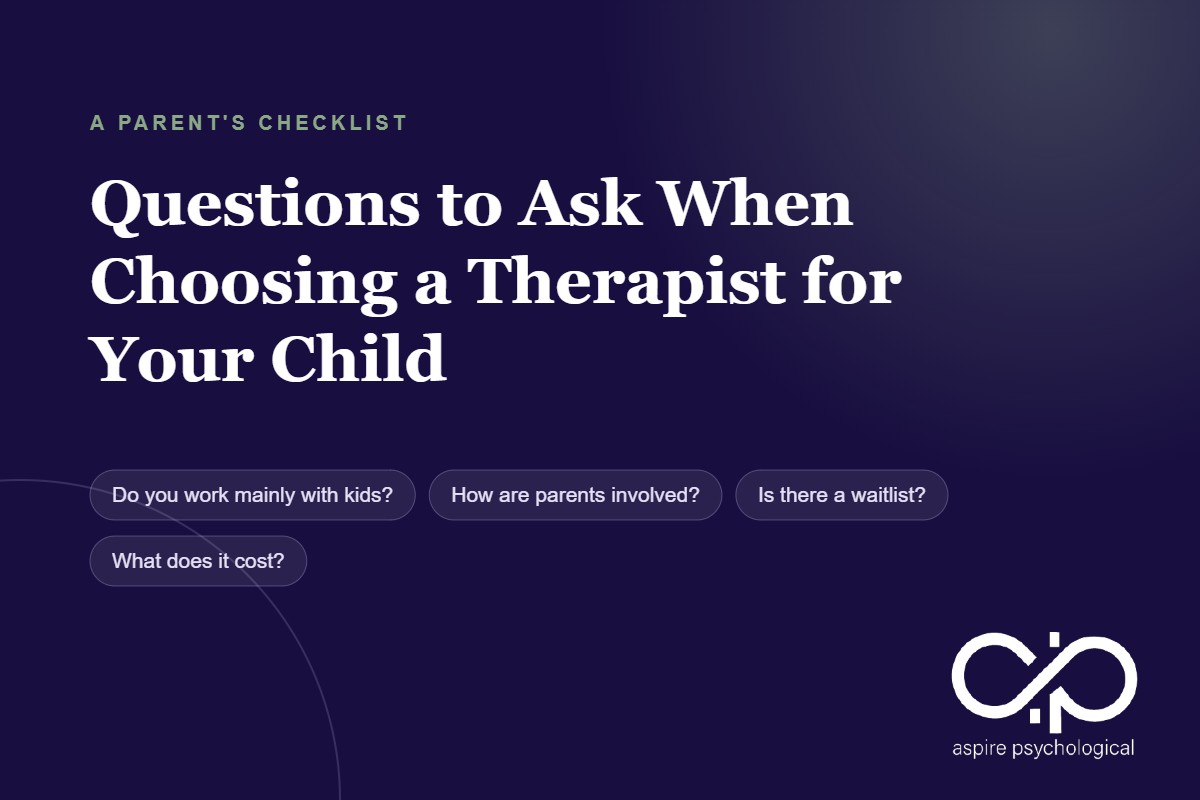
Questions to Ask When Choosing a Therapist for Your Child
Choosing a therapist for your child? Here are the questions to ask on the first call, about experience with kids, parent involvement, waitlists and cost, and what to listen for.

What Happens When You Call Our Office: A Parent’s Guide to Getting Started
What really happens when you call a child therapy office? A step-by-step look at the first call, cost, scheduling and your first visit at Aspire.

Out-of-Network Therapy in Bergen County | Aspire
Out-of-Network Therapy in Bergen County: What It Actually Means for Your Family How does out-of-network therapy work, and what will it actually cost? Out-of-network therapy means paying the practice directly instead of billing insurance upfront. At Aspire, most families with OON benefits get back 50 to 80 percent