

Is your child suddenly refusing camp, complaining of stomachaches, or begging to stay home? Learn what anxiety experts recommend, and what parents can do today to help.
Every June, pediatric therapists see the same pattern: a child who was fine at pickup in May suddenly refuses to get out of the car at camp. Parents often assume it is a phase, a personality clash, or a sign the camp is wrong. In most cases, it is anxiety, and it responds to the same evidence-based approach used for school refusal.
Quick Answer: If Your Child Refuses Camp Because of Anxiety
- Don’t immediately let them stay home.
- Validate the feeling, but avoid reinforcing the avoidance.
- Reduce accommodations gradually rather than all at once.
- Use step-by-step exposure to rebuild tolerance.
- Seek professional help if refusal continues for more than several days.
Understanding Camp Refusal
Camp refusal often doesn’t look like anxiety at first. It shows up as stomachaches on drop-off mornings, tears at the car door, sudden complaints that camp is “boring” or “the kids are mean,” or a flat refusal with no explanation at all. Parents are left choosing between forcing a miserable child through the door or letting them stay home, neither of which feels right.
The research on childhood anxiety and avoidance gives a clearer path. A substantial body of evidence shows that well-intentioned parental accommodation, such as allowing a child to skip camp, providing excessive reassurance, or restructuring the family’s summer around the child’s fears, actually maintains and worsens anxiety symptoms over time by reinforcing avoidance.
Is It Anxiety, or Is the Camp Actually the Problem?
Before assuming anxiety is the driver, it helps to rule out a genuine, specific problem at camp. Both are real possibilities, and they call for different responses.
| Signs It’s Anxiety | Signs It’s a Camp Problem |
|---|---|
| Wants to stay home in general | Complains about one specific counselor |
| Symptoms disappear once at home | Reports bullying consistently, across days |
| Fear or complaint changes day to day | Complaints are specific and stay the same |
| Avoids many activities, not only camp | Only dislikes this one activity or group |
Anxiety also tends to show up across three overlapping categories of symptoms. Recognizing the pattern can help you name what your child is experiencing.
Emotional
- Fear
- Panic
- Worry
Physical
- Stomachache
- Headache
- Nausea
Behavioral
- Refusal
- Clinging
- Crying
Parent Self-Assessment: Could Anxiety Be Driving the Refusal?
Check All That Apply
This is an informal screening tool, not a diagnosis. Use it as a starting point for a conversation with a clinician if you have concerns.
Recognize this pattern in your child?
The Accommodation-Avoidance Cycle
When a child refuses to go to camp because of anxiety, the natural parental instinct is to allow the avoidance in order to reduce the child’s distress in the moment. That relief is real and immediate, which is exactly why the pattern is so easy to fall into and so hard to break. The problem is what happens next.
Child feels anxious about camp and resists going
Parent accommodates: lets the child skip, over-reassures, or negotiates
Child’s anxiety drops immediately, avoidance is reinforced
Child learns camp truly was too dangerous or unbearable to face
Next request to attend triggers even stronger resistance
This is the accommodation-avoidance cycle. Greater family accommodation has been directly linked to greater avoidance behavior and lower child self-efficacy. The child never gets the chance to discover, through direct experience, that the feared situation was manageable and that their own distress would naturally decline if they stayed in it. That process, called habituation, cannot happen if the child leaves the anxiety-provoking situation every time.
The Key Insight for Parents
Accommodation is not weak parenting. It is a loving, instinctive response to a child’s distress. But comfort in the moment and long-term resilience are sometimes in tension, and the research is consistent that reducing accommodation, done carefully and gradually, is one of the most effective things a parent can do.
Why Camp Refusal Mirrors School Refusal
Clinically, camp refusal and school refusal are the same phenomenon presenting differently. Both involve a structured environment where showing up is expected every day, whether the child feels like it or not, along with separation from a trusted caregiver, social evaluation, and a degree of unpredictability. The mechanism driving avoidance, anticipatory anxiety followed by negative reinforcement when avoidance is permitted, is identical in both settings.
What Camp and School Refusal Share
- Separation from parent or trusted figure
- Novel or shifting social dynamics
- A daily, non-negotiable attendance expectation
- Physical symptoms on transition mornings
- Escalation once even one absence is permitted
Why This Matters for Treatment
- The same SPACE and CBT protocols apply directly
- Summer is a lower-stakes window to build skills
- Progress at camp often reduces fall school-refusal risk
- Parents can practice accommodation reduction now
- A therapist does not need a separate “camp protocol”
This overlap is genuinely useful. Summer offers a lower-stakes environment to practice reducing accommodation and building tolerance for discomfort before the higher-stakes environment of the school year returns in the fall. Families who address camp refusal proactively often see a smoother September as a result.
What the Research Shows
Overprotective parenting that limits a child’s opportunities to encounter and master frightening circumstances is an established environmental risk factor for the development and persistence of anxiety disorders. Conversely, family-directed interventions that improve parent-child communication, reduce parental anxiety, and build anxiety-reducing parenting skills are recommended as a supplement to individual treatment.
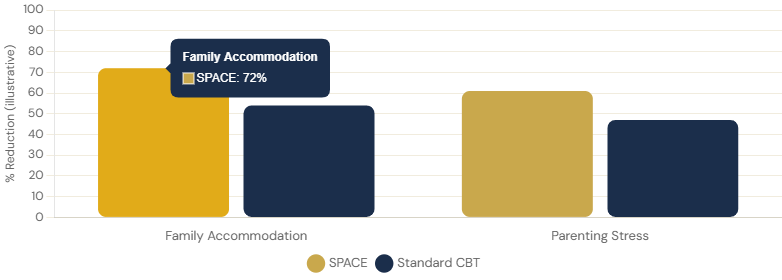
Family Accommodation Reduction: SPACE vs. Standard CBT
Common Parental Accommodation Behaviors Reported by Families of Anxious Children

Cognitive Behavioral Therapy remains the first-line treatment for mild to moderate childhood anxiety, including camp and activity avoidance. Research consistently shows that more time devoted to exposure practice, particularly to the more difficult steps in the hierarchy, predicts better outcomes.
Want a personalized plan for your child?
SPACE: A Parent-Only Treatment That Works Even When the Child Refuses
One of the most useful findings for camp refusal specifically is SPACE, Supportive Parenting for Anxious Childhood Emotions. A landmark randomized noninferiority trial of 124 children ages 7 to 14 demonstrated that SPACE, a parent-only treatment program with no direct child-therapist contact, was as effective as child-focused CBT for childhood anxiety disorders.
This matters enormously for camp refusal, because many of the children who refuse camp also refuse to talk to a therapist about it. SPACE sidesteps that obstacle entirely by working through the parent.
What Parents Learn in SPACE
- How to identify and systematically reduce their own accommodating behaviors
- How to deliver supportive acknowledgment of the child’s distress while simultaneously expressing confidence in the child’s ability to cope
- How to communicate planned changes to the child in advance, rather than springing them unexpectedly
- How to tolerate their own discomfort as the child’s distress temporarily rises before it falls
In the trial, family accommodation and parenting stress were both significantly reduced, with a greater reduction in accommodation seen in SPACE compared to standard CBT. For a family whose child point-blank refuses to discuss camp, SPACE offers a genuine, well-supported path forward.
Graduated Exposure: Building a Camp Ladder
For children who are willing to engage in treatment directly, graduated exposure works by breaking the feared situation into a hierarchy of smaller, more manageable steps. Each step is practiced until anxiety naturally declines before moving to the next. A typical camp exposure ladder might look like this:
Drive past the camp building together, no expectation to go in
Visit the camp during off-hours to see the space and meet a counselor
Attend for one hour with a parent present nearby
Attend a half day independently, with a planned pickup time
Attend a full day independently, same as peers
Pediatric anxiety experts recommend adjusting each step to fit your child’s age and personality. For younger children, this might mean using pretend play to practice being brave, having a sibling or friend show them it’s safe to try, or using a favorite character or story to model courage. Small rewards, like a sticker chart or a special treat, for completing each step can also make a real difference.
CBT Beyond Exposure: The Full Toolkit
Graduated exposure gets the most attention, but Cognitive Behavioral Therapy for childhood anxiety is a full, structured treatment made up of several components that build on each other. Understanding the full picture helps parents know what to expect from treatment and why it works over time, not just in a single hard morning.
1. Psychoeducation: Understanding the Alarm System
Treatment typically begins with children and parents learning how anxiety actually works in the body and brain. Anxiety is the body’s built-in alarm system, designed to protect us from real danger. In an anxious child, that alarm often goes off for situations that are uncomfortable but not actually dangerous, like walking into a bunk of new kids. Understanding that anxiety is a false alarm, not a real danger signal, takes some of the mystery and fear out of the experience and gives families shared language to talk about it.
2. Recognizing and Questioning Anxious Thoughts
Children learn to notice the specific thoughts that fuel their worry, such as “something bad will happen” or “I won’t be able to handle it.” A therapist helps the child gently test those thoughts against evidence: has something bad actually happened at camp before, and if a hard moment did happen, what did the child do? Over time, children build the habit of questioning the alarm instead of automatically believing it.
3. Coping and Calming Skills
Simple, concrete tools give children something to do when anxiety spikes, rather than feeling at its mercy. Common skills taught in CBT include slow, deep breathing, grounding exercises that use the five senses, and progressive muscle relaxation. These are not meant to eliminate anxiety, but to help a child’s body settle enough to face the situation.
4. Graduated Exposure
As covered in the next section, exposure is the process of facing feared situations in small, manageable steps, in order from easiest to hardest. It is the component most directly responsible for helping a child’s brain relearn that camp is safe, because that lesson can only be learned through actually experiencing it and getting through it.
5. Problem-Solving Skills
Children practice thinking through a worry step by step: what is the actual problem, what are some realistic options, and what is one reasonable next step, instead of spiraling in the fear itself. This gives children a concrete process to fall back on when a new worry pops up that was not part of the original exposure ladder.
6. Rewards and Positive Reinforcement
Praise and small incentives for brave behavior, not for the absence of anxiety, help children build motivation to keep practicing hard things. The reward is for walking in the door despite feeling anxious, not for feeling calm. This distinction matters, because it teaches children that courage, not the disappearance of fear, is the goal.
7. Relapse Prevention
Toward the end of treatment, families learn how to recognize early signs of the pattern returning, such as a new round of morning stalling or reassurance-seeking, and how to respond quickly using the same tools. This step is what helps gains made over the summer carry into the school year, rather than resetting each time a new environment or transition comes up.
5 Mistakes That Accidentally Make Camp Refusal Worse
Negotiating every morning. Repeated back-and-forth at drop-off signals that resistance might change the outcome, which can intensify the daily battle.
Reassuring repeatedly. Answering “will I be okay?” over and over can unintentionally reinforce the idea that there is real reason to doubt it.
Promising “you can leave if…” Offering an escape hatch undermines the exposure process before it has a chance to work.
Punishing anxiety. Consequences for tears or resistance can add shame on top of fear, without addressing the anxiety itself.
Waiting weeks hoping it improves on its own. Avoidance tends to strengthen with time, so early action is more effective than waiting it out.
What to Say Instead of “You’ll Be Fine”
Parents often ask for the exact words to use at a hard drop-off. Here is a simple script grounded in the SPACE approach of validating distress while expressing confidence.
Practical Strategies Parents Can Start This Week
- Reduce accommodation gradually, not abruptly. Pick one accommodating behavior to phase out first, such as no longer allowing a full-day skip, before tackling others.
- Use a calm, matter-of-fact morning script. Avoid lengthy negotiations or repeated reassurance at the door, which can inadvertently reinforce the anxiety.
- Build the exposure ladder together in a calm moment. Involve your child in choosing the steps when possible, which increases buy-in.
- Communicate changes in advance. Tell your child the night before, not in the car, that today you will not be turning around.
- Reinforce the courage, not just the outcome. Praise the act of walking in the door, separate from how the day went.
- Manage your own anxiety. Parental anxiety and overprotection contribute directly to the cycle, so addressing your own stress response is part of effective treatment.
- Loop in the camp. A brief conversation with a counselor or director about a gradual reentry plan can align adult expectations.
What to Do Today
Morning
- Stay calm
- Keep the routine consistent
- Avoid arguing or over-explaining
During Camp
- Don’t text or call repeatedly
- Let staff handle transitions
- Trust the plan you’ve set
Evening
- Praise the bravery, not just a good day
- Don’t interrogate about every detail
- Keep the tone light and forward-looking
When to Seek Professional Support
Some camp refusal resolves with the strategies above. Other cases benefit from professional guidance, particularly when avoidance is entrenched or the family feels stuck in the cycle. Consider reaching out to a clinician if:
- Refusal has persisted for more than a few days despite a calm, consistent response
- Physical symptoms such as stomachaches, headaches, or panic accompany drop-off
- The pattern is escalating rather than improving
- Family conflict around mornings is rising
- You worry the pattern will carry into the school year
Early professional support, through SPACE or CBT with graduated exposure, resolves most cases of camp refusal. The earlier a family engages with an evidence-based approach, the faster the pattern typically improves.
A Note from Dr. Berlin
In more than two decades of clinical work, including a decade as a counseling director in a school setting, I have seen how quickly camp refusal can turn into a summer-long standoff, and how quickly it can also turn around with the right, evidence-based approach. Parents are not failing their child by seeking help. They are giving their child the tools to face what feels big right now.
Ready to break the anxiety cycle?


