

Every meal ends in tears. Your child eats only beige foods. Birthday parties create panic instead of excitement. You’ve tried bribing, rewarding, bargaining, threatening, and nothing works. If that sounds familiar, your child may have something very different from ordinary picky eating.
What Is ARFID? (Quick Answer)
ARFID, or Avoidant/Restrictive Food Intake Disorder, is more than picky eating. Children with ARFID avoid food because of sensory sensitivities, fear of choking or vomiting, or genuinely little interest in eating.
Unlike typical picky eating, ARFID can lead to
- Weight loss
- Poor growth
- Nutritional deficiencies
- Dependence on supplements
- Significant family stress
Three drivers behind it
- Sensory sensitivities
- Fear of aversive consequences
- Low interest in eating
How Common Is ARFID?
ARFID is far more common than most parents realize, and diagnosis rates have been climbing as awareness among pediatricians and therapists grows.
Diagnosis has increased in recent years, partly because ARFID was only formally added to the DSM in 2013 and clinicians are still catching up on recognizing it, and partly because awareness among parents and pediatricians has grown. It can begin in infancy, but it’s also increasingly recognized in preschoolers, school-age children, teenagers, and even adults who were never diagnosed as children.
When Should I Worry? Red Flags to Watch For
Reach out if you’re seeing:
Not Sure If It’s ARFID or a Phase?
The clearest way to find out is a full intake appointment, where we take a real look at your child’s eating history, growth, and patterns, rather than trying to guess from a quick call.
Typical Picky Eating vs. ARFID
This is the question almost every parent asks first: “How do I know this isn’t just picky eating?” Here’s the difference at a glance.
| Typical Picky Eating | ARFID |
|---|---|
| 30–40 accepted foods | Sometimes fewer than 20 |
| Still growing on track | Growth or weight affected |
| Will eat something at a party | Avoids social events built around food |
| Food list slowly expands with age | Food list stays flat or shrinks |
| Annoying, but manageable | Clinically impairing |
How ARFID Differs From Similar Conditions
ARFID is frequently confused with several other conditions. Here’s the core distinction for each.
| Condition | Core Difference From ARFID |
|---|---|
| Anorexia Nervosa | Driven by body image and a desire to lose weight or control shape. ARFID restriction has nothing to do with weight or appearance. |
| Sensory Processing Disorder | SPD involves broad sensory sensitivities across touch, sound, and movement, not just food. ARFID’s sensory profile is food-specific, though the two can overlap. |
| Autism | Autism is a separate neurodevelopmental diagnosis. Food selectivity is common in autism, but most autistic children don’t meet full ARFID criteria, and most children with ARFID aren’t autistic. |
| OCD (Contamination Fears) | OCD-driven avoidance centers on contamination, germs, or “wrongness,” with rituals attached. ARFID’s fear profile centers on a specific physical consequence, like choking or vomiting. |
The Three Profiles Behind ARFID
Not all ARFID looks the same. Researchers describe three distinct drivers, and most children lean heavily toward one or two of them. Identifying which one (or ones) are at play is the single most important step in choosing the right treatment.
🍞 Sensory Sensitivity
Food is avoided because of how it looks, smells, tastes, or feels in the mouth. Texture and temperature can matter more than flavor. This is the profile people usually picture when they think “picky eater,” but it can be far more rigid and far more limiting.
⌛ Low Interest / Low Appetite
Eating simply doesn’t register as important or enjoyable. These children forget to eat, fill up after a few bites, and rarely ask for food. It often looks like a low drive to eat rather than active avoidance.
⚠️ Fear of Aversive Consequences
Often traced to a specific frightening event (choking, vomiting, an allergic reaction) or intense worry about one. Avoidance escalates quickly and can generalize to entire food categories almost overnight.
Common Myths About ARFID
What Makes ARFID Worse?
Well-meaning strategies can accidentally reinforce the very patterns you’re trying to break. Five to watch for:
- Making separate meals every night. It solves the immediate mealtime battle but removes any pressure to expand.
- Pressuring your child to clean their plate. Pressure tends to increase anxiety around food, not decrease avoidance.
- Negotiating every bite. Bargaining teaches that resistance gets results, and it keeps every meal a negotiation.
- Labeling your child “picky.” The label can become part of their identity and make change feel less possible.
- Avoiding restaurants and social eating forever. It shrinks their world along with their food list.
What Often Comes Along With ARFID
ARFID rarely shows up alone. A large Swedish population study of over 30,000 children found significantly elevated rates of several co-occurring conditions.
Co-Occurring Conditions in Children With ARFID
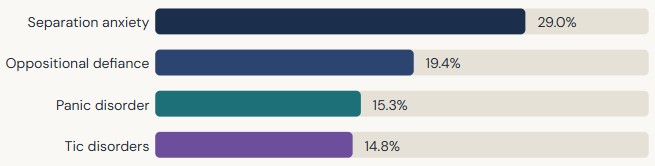
Children with ARFID also show significantly higher odds of an autism diagnosis (13.7x) and ADHD diagnosis (9.4x) compared to children without ARFID.
Anxiety disorders of any kind co-occur in roughly 71% of ARFID cases.
None of this means every anxious or neurodivergent child will develop ARFID, or that every child with ARFID has another diagnosis. But it does mean a thorough evaluation should look at the whole picture, not just the plate.
Wondering If This Sounds Like Your Child?
You don’t need a diagnosis in hand to get started. A full intake appointment is where we actually dig into your child’s history and figure out what’s going on and what to do about it.
What Actually Works: Evidence-Based Treatment
The good news is that ARFID is treatable, and treatment doesn’t rely on guesswork. Two approaches currently have the strongest research support, and the right one often depends on your child’s age and which profile is driving the avoidance.
CBT-AR: Cognitive Behavioral Therapy for ARFID
CBT-AR is a structured, modular therapy built specifically for this diagnosis, typically delivered over 20 to 30 sessions and appropriate for children as young as 10 through adulthood. It moves through four stages: psychoeducation, building a regular eating rhythm, targeted work on the specific mechanism driving avoidance (sensory, fear, or low interest), and relapse prevention.
CBT-AR: How Much Each Mechanism Improves With Treatment
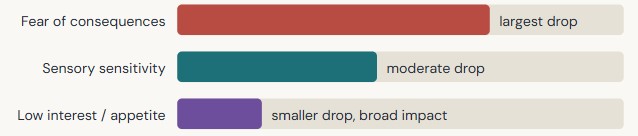
The low-interest mechanism improves even without a module targeted at it directly, likely from the regular-eating structure built into every stage of CBT-AR. Fear responds fastest and most fully to targeted exposure work.
In the largest real-world study to date (549 adults treated virtually), every profile improved significantly, and children requiring weight restoration gained an average of about a third of a pound per week during treatment, a meaningful and steady pace.
Family-Based Treatment for ARFID (FBT-ARFID)
For younger children, particularly ages 6 to 12, Family-Based Treatment puts parents in the driver’s seat of expanding their child’s diet, with a therapist coaching from the sidelines rather than running exposures directly with the child. The only adequately powered randomized controlled trial in ARFID found FBT-ARFID outperformed individual motivational therapy at restoring healthy weight, and the most severely affected children benefited the most.
| Approach | Best Fit | What It Looks Like |
|---|---|---|
| CBT-AR | Ages 10 and up (children through adults) | Individual therapy targeting the specific mechanism (sensory, fear, or interest) with graduated exposure and self-monitoring |
| FBT-ARFID | Ages 6–12 | Parents actively lead meal expansion at home, coached weekly by a therapist |
| Inpatient / intensive | Medically compromised cases | Structured meal plans and multidisciplinary medical support in a higher level of care |
How Long Does Treatment Take?
There’s no single answer, but here’s what the research points to as a general range:
- CBT-AR typically runs 20 to 30 sessions, roughly 5 to 8 months, depending on how many of the three mechanisms need targeted work.
- FBT-ARFID in the largest clinical trial to date used 14 sessions over about 4 months.
- Children with a strong fear-of-choking or fear-of-vomiting driver often see faster movement, since exposure-based treatment tends to work quickly once it starts. Sensory sensitivity and low interest tend to take longer and steadier work.
Can ARFID Be Cured?
“Cured” isn’t quite the right word for how clinicians think about it, but the outlook is genuinely good. Treatment doesn’t aim to make your child love every food. It aims to expand what they can eat safely and confidently, reduce the fear or friction around meals, and get nutrition and growth back on track. Many children reach a point where they no longer meet criteria for ARFID at all. Others continue to have a narrower list of preferred foods than average but no longer experience the weight loss, nutritional risk, or family conflict that made it a clinical concern in the first place. Left untreated, research following children over two years found about half still met criteria for ARFID, so treatment meaningfully changes the odds.
What Do I Actually Say? Parent Scripts
Parents ask this more than almost anything else. Small shifts in language can lower the pressure at the table without lowering the expectation to keep practicing.
“Just take one bite.”
“I know this feels uncomfortable. Let’s practice together. You don’t have to like it. You just have to practice.”
“You didn’t even try it.”
“Looking at it and touching it counts as practice too. We’ll keep going at your pace.”
What Happens During an Evaluation?
We hear from a lot of nervous parents before the first appointment, so here’s exactly what to expect. An ARFID evaluation typically includes:
- Parent interview: understanding your family’s day-to-day experience with mealtimes
- Food history: mapping which foods are accepted now, which were lost, and when
- Growth review: looking at your child’s growth chart and any flagged labs with you
- Anxiety screening: checking for fear-based avoidance and any related anxiety
- Treatment planning: matching your child’s profile to CBT-AR, FBT-ARFID, or a blended approach
What Happens Next? A Realistic Timeline
Week 1
Evaluation and initial food and growth history.
Weeks 2–4
Understanding your child’s specific eating patterns and building the treatment plan.
Month 2
First food exposures, matched to your child’s profile and pace.
Month 3
Expanding the accepted food list and building consistency.
Long-Term
Generalizing progress to new settings: school, restaurants, family events.
Should You Wait or Get Evaluated?
What Parents Can Do This Week
Families often tell us that simply understanding why their child eats this way helps reduce guilt and conflict around meals, even before treatment formally begins.
ARFID Across Ages and Related Concerns
ARFID doesn’t look the same at every age, and it rarely shows up in isolation. A few areas worth understanding:
ARFID in Preschoolers
Often first shows up as feeding difficulty rather than a formal diagnosis. Early intervention tends to prevent years of entrenched avoidance.
ARFID in Teenagers
Can develop later than expected, sometimes after a medical scare, and is often mistaken for typical teenage stubbornness about food.
ARFID and ADHD
Children with ARFID have significantly higher odds of an ADHD diagnosis. Low interest in eating can overlap with inattention to hunger cues.
ARFID and Autism
More common among autistic children, with sensory sensitivity often the primary driver, though most children with ARFID are not autistic.
ARFID and OCD
Fear-driven ARFID can resemble OCD’s need for certainty, but the fear is typically tied to one specific physical consequence rather than contamination or ritual.
ARFID After Choking or Vomiting
One of the most common triggers for sudden-onset, fear-driven ARFID. Avoidance can spread quickly to entire food categories.
Role of Occupational Therapy
Can help with the sensory-motor side of eating, like oral motor skills or sensory tolerance work, often alongside psychotherapy.
Role of Registered Dietitians
Support nutritional adequacy and can help translate treatment goals into a practical, balanced meal plan at home.
Key Takeaways
- ARFID is not picky eating. It’s a diagnosable feeding and eating disorder that can affect growth, nutrition, and daily life.
- It has three main drivers: sensory sensitivity, low interest in food, and fear of aversive consequences, often in combination.
- It often travels with anxiety, ADHD, or autism, but plenty of children with ARFID have none of those diagnoses.
- Left untreated, it tends to stick around. About half of children still meet criteria two years later without help.
- Treatment works. CBT-AR and Family-Based Treatment both have real evidence behind them, and the right fit depends on your child’s age and profile.
Ready to Take the Next Step?
If any of this sounds familiar, you don’t have to wait for things to get worse to reach out. Early support tends to be easier for the whole family.
You Don’t Have to Figure This Out Alone
If mealtimes have become a source of dread in your home, the next step is a full intake appointment, not a quick phone call. Aspire Psychological Group works with children, adolescents, and families across Bergen County, NJ and Rockland County, NY, with telehealth available throughout both states.
Licensed psychologist
Child anxiety specialist
Serving NJ & NY
Telehealth available
Superbills provided for out-of-network reimbursement


