

Your teenager seems off: snapping at everyone, shutting down, melting down over things that didn’t used to matter. Here’s what the research says about what’s really going on, and what actually moves the needle.
- Seems constantly overwhelmed or on edge
- Refuses school or avoids activities they used to love
- Melts down or snaps over small things
- Has become withdrawn, irritable, or unreachable
- You’re not sure if this is “normal” or something more
- Teen anxiety often looks like anger or avoidance, not worry
- Avoidance makes anxiety worse over time
- CBT and ACT have the strongest research behind them
- Family patterns can maintain or reduce anxiety
- Earlier help almost always means easier recovery
Up to 1 in 4 teenagers will have a diagnosable anxiety disorder by late adolescence. Not “stressed about a test.” A real, clinical anxiety disorder. And research shows the average delay before anxiety disorders are first treated is 9 to 23 years. That means many teenagers who struggle don’t get help until they’re adults.
If your teenager seems like they’re struggling. Shutting down, melting down, avoiding everything. This post is for you. We’re going to cover what anxiety actually looks like in teenagers (including the signs most parents miss), where it comes from, and what the research says actually helps.
If This Sounds Like Your Kid, You’re Not Imagining It
Most parents who call describe some version of this: their teenager used to be mostly fine, or at least manageable, and then something shifted. Maybe gradually, maybe suddenly. Now they’re watching their teenager shut down, snap at everyone, refuse to go places, and they can’t tell if it’s normal teenage stuff or something that needs real attention.
Here’s what matters: anxiety disorders are the most common psychiatric conditions in adolescents. They frequently co-occur with depression and ADHD. And they are highly responsive to the right treatment.
The part that makes it hard is that anxiety in teenagers rarely looks the way parents expect. It doesn’t usually look like a teenager sitting there wringing their hands and saying “I’m scared.” It looks like a teenager who’s irritable, avoidant, rigid, or checked out. Which means it gets missed. A lot.
Up to 1 in 4 teens will develop an anxiety disorder by late adolescence, making them the most common mental health condition in young people. Untreated anxiety often persists into adulthood. That is exactly why early identification matters.
What Anxiety Is Actually Doing in Your Teen’s Brain
Before we talk symptoms, it helps to understand the basic mechanism. When your teenager finally understands what’s happening in their own brain, everything starts to shift.
Two brain regions drive the anxiety experience:

The Amygdala
The brain’s alarm system. Ancient, fast, and completely non-rational. Its job: detect danger and fire a response in milliseconds, before the thinking brain knows what’s happening.

The Prefrontal Cortex
The “braking” system: rational, calm, deliberate. Its job: evaluate whether the threat is real and tell the amygdala to stand down. In anxious teens, this connection is traffic-jammed.
When the amygdala fires, your teen’s body shifts into fight-or-flight: heart races, muscles tense, digestion slows. This is the exact same system that protected our ancestors from physical danger. The problem is it cannot tell the difference between a tiger and a math test.
The important news: this traffic jam is not permanent. The brain changes with experience. Every coping skill your teenager learns is literally rewiring that connection between the amygdala and the prefrontal cortex.
The Anxiety-Avoidance Cycle: Why It Keeps Going
 Trigger
A situation activates the amygdala (social situation, test, uncertainty)
 Anxiety Spikes
Fight-or-flight response floods the body with stress hormones
 Avoidance
Teen escapes or avoids the situation, and anxiety drops immediately
 Negative Reinforcement
Brain learns: “Avoidance = relief.” The connection strengthens.
 World Gets Smaller
More situations trigger the response. Anxiety grows. Life shrinks.
Avoidance provides immediate relief. That is exactly why it’s so hard to stop, and why it makes anxiety worse over time.
What Teen Anxiety Actually Looks Like
Everyone knows the obvious signs: excessive worry, trouble sleeping, racing heart. But teen anxiety is a skilled disguise artist. The presentations most parents miss are often the ones keeping their teenagers stuck longest.
The Obvious Signs

Excessive Worry
Worry that feels out of proportion to the situation, or that jumps from topic to topic.

Sleep Problems
Trouble falling asleep, waking repeatedly, or needing to be “talked down” before bed.

Physical Symptoms
Palpitations, shortness of breath, chest tightness, dizziness, muscle tension.

Avoidance
Refusing activities, social situations, or school, especially things they used to enjoy.
 Commonly Missed
The following presentations are frequently mistaken for attitude problems, laziness, or personality traits. Recognizing them as anxiety changes everything about how to respond.


“Anxious teenagers often don’t look worried. They look angry. I cannot count how many teenagers I’ve worked with who were labeled as having attitude problems when what they actually had was untreated anxiety.”
Dr. Aryeh Berlin, PsyD | Aspire Psychological Group
We help parents figure out whether what they’re seeing crosses the line from normal stress into something that needs clinical attention. The first step is a conversation.
Private pay. Superbills provided for out-of-network reimbursement.
Where Teen Anxiety Comes From
Anxiety isn’t caused by a single thing. It’s a convergence of biology, learning, and environment. Understanding which factors are at play matters for choosing the right approach.
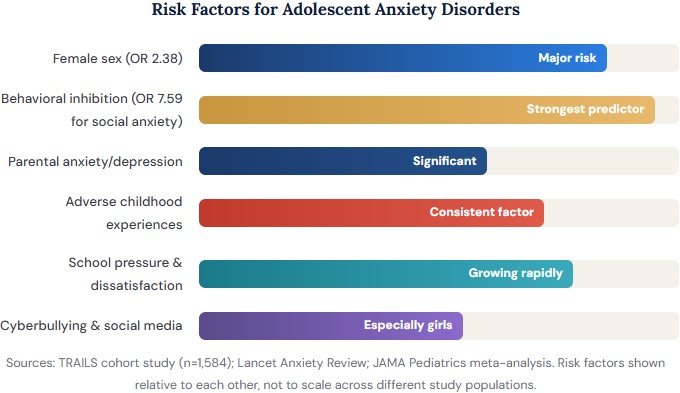
Biology: Some Teens Are Wired for Vigilance
Anxiety shows 30–50% heritability. The strongest early predictor is a trait called behavioral inhibition, identifiable in toddlers, characterized by slowing in the presence of novelty, clinging to familiar people, and withdrawal from unfamiliar situations. Teens with behavioral inhibition are over seven times more likely to develop social anxiety disorder.
This is not a parenting failure. It is temperament. And temperament is not destiny.
The World They’re Growing Up In
A Norwegian study tracked nearly one million adolescents over 13 years (2011–2024) and found that rising school dissatisfaction accounted for the largest share of increasing mental distress. More than social media. Social media contributed too, but the relentless academic pressure to perform and plan is the dominant driver.
And then COVID happened. A meta-analysis of 80,000+ youth found that roughly 1 in 5 teens showed clinically elevated anxiety during the pandemic, with rates continuing to rise as it wore on and disproportionately affecting girls. Recovery has been slow. Your teenager’s generation had a formative chunk of adolescence disrupted, and the psychological consequences are still unfolding.
If your teenager is struggling, they are not soft. They are not overreacting. They are growing up in a measurably harder environment than previous generations, layered on top of whatever biological vulnerabilities they were born with. Naming that matters.
What Actually Helps: The Research-Backed Toolkit
There is strong evidence for what works. The research consistently points to five categories, united by one principle that runs through all of them: the antidote to anxiety is approach, not avoidance.
Evidence-Based Treatments for Teen Anxiety: How They Compare
| Approach | What It Focuses On | How Strong Is the Evidence | Best For |
|---|---|---|---|
| CBT Cognitive Behavioral Therapy | Changing thought patterns; gradually facing feared situations | ★★★★★ The most studied anxiety treatment for teens. Very strong track record. | Specific anxiety disorders (social anxiety, GAD, panic) |
| ACT Acceptance & Commitment Therapy | Changing your relationship to anxious thoughts; living by your values even when anxious | ★★★★☆ Comparable results to CBT. Good option when CBT hasn’t been the right fit. | Stress, anxiety across multiple areas, when CBT hasn’t fully worked |
| Exposure Therapy | Systematically facing feared situations to build new safety memories | ★★★★★ The single most powerful ingredient in anxiety treatment. | Any anxiety involving avoidance (which is most) |
| Mindfulness (MBI) | Present-moment awareness; reducing reactivity to anxious thoughts | ★★★☆☆ Helpful for stress regulation. Works best combined with CBT or ACT. | Stress regulation; best as an add-on, not standalone |
| Cognitive Restructuring alone | Challenging the accuracy of anxious thoughts | ★★★☆☆ Effective, but works better when paired with exposure. | Catastrophizing, worst-case-scenario thinking |
Sources: Cochrane review (60+ randomized controlled trials, n=6,978); López-Pinar et al. 2025 meta-analysis.
Understanding the Brain’s Alarm System
When teenagers understand what their brain is doing during anxiety and learn to recognize “this is my amygdala firing, not actual danger.” The second layer of fear (being scared of the anxiety itself) drops significantly. Psychoeducation is one of the most powerful, and most underrated, interventions available.
Slow Breathing: Done Right
Box breathing uses equal timing on every count, making it easy to learn and easy to practice under pressure. The structured rhythm gives the nervous system something to focus on while your breathing slows down, which is what activates the parasympathetic system. It works best when practiced daily in calm moments, not just during crises.
Facing the Feared Situation (Exposure)
This is the most potent single ingredient in anxiety treatment. Exposure therapy involves systematically approaching feared situations. It creates new “safety memories” that compete with and override the original fear association. The goal isn’t to make anxiety disappear during the exposure; it’s to collect evidence that the feared outcome doesn’t happen, or that it’s survivable. Every prediction that doesn’t come true rewires something real.
Changing the Relationship to Anxious Thoughts
CBT targets thought accuracy: “Is the evidence really there for this catastrophic prediction?” ACT targets thought grip: “I notice I’m having the thought that I’m going to fail. I don’t have to treat that as a fact.” Both approaches work. The key is that teens learn to act like the person they want to be even while anxious thoughts are present, not waiting until the thoughts are gone.
Values-Based Action
Anxious teens often organize their entire lives around avoidance. When the organizing principle shifts from “avoid bad feelings” to “move toward what matters to me.” Anxiety’s grip on behavior loosens. ACT research shows that acting in line with personal values despite anxiety predicts sustained improvement. Don’t wait until the anxiety is gone to start living.
Box Breathing: Try It Right Now
Follow this pattern. Repeat twice. Notice how your nervous system responds.
What Doesn’t Work. And Why.
Some of the most natural parental responses to teen anxiety are also the ones that accidentally keep it going. Understanding why helps parents stop patterns that feel helpful but aren’t.


When to Get Professional Help
Coping skills matter. Parenting strategies matter. And sometimes, the most important thing a parent can do is recognize that their teenager needs more than home-based support.
Consider reaching out to a licensed child psychologist when anxiety is interfering with daily functioning: school attendance, friendships, family life, sleep, or activities your teen used to enjoy.
Signs It’s Time to Seek Professional Support
 School refusal or significant avoidance
- Symptoms present for more than 4–6 weeks
- Friendships deteriorating
- Activities they used to love now avoided
- Any mention of hopelessness or self-harm
 Structured assessment before jumping to treatment
- Evidence-based approach (CBT and/or ACT)
- Parental involvement appropriate to age
- Exposure as a core component
- Clear goals and measurable progress
What Parents Say About Working With Dr. Berlin
Your Teenager Doesn’t Have to Keep White-Knuckling This
Aspire Psychological Group works with children and adolescents in Bergen County, NJ and Rockland County, NY using evidence-based approaches, including CBT, ACT, and SPACE Treatment. Every case starts with a thorough assessment so the approach actually fits your child.
Call 201-639-4669
Private pay only. Superbills provided for out-of-network reimbursement.


