

What is Parenting Burnout? Beyond the Everyday Stress
It’s July. Your children are home all day. The house is louder, messier, and somehow everyone seems more irritable. You thought summer would be easier. Instead, you’re counting down the days until school starts. You snap at minor things. You feel disconnected from your children even as you’re managing their every need. You’re wondering if you’re failing as a parent.
What you’re experiencing isn’t weakness or poor parenting. It’s likely parenting burnout, and it’s far more common than you think.
Parenting burnout occurs when parenting demands consistently exceed available resources. During summer months, loss of routine, increased childcare demands, and disrupted schedules can increase both parental stress and child anxiety. Research suggests maintaining sleep schedules, meal routines, and daily physical activity are among the most effective protective factors. A 2025 meta-analysis found that 6-week structured programs incorporating stress management, cognitive reappraisal, and relational support show the largest effects.
But parenting burnout is different from the typical stress of raising children. It’s not something that gets better with a good night’s sleep or a weekend off.
Parenting burnout is a multidimensional syndrome characterized by four key experiences:
Are You Experiencing Parenting Burnout?
Check any that apply:
I feel emotionally exhausted by parenting
I have less patience than usual
I dread parenting responsibilities
I feel disconnected from my children
I often wonder whether I’m failing as a parent
Score: 0-1 = mild stress | 2-3 = elevated stress | 4+ = consider professional support
Emotional Exhaustion
Feeling drained, depleted, and unable to handle the emotional demands of parenting.
Emotional Distancing
Creating psychological distance from your children, feeling detached from the parent-child relationship.
Loss of Enjoyment
Losing pleasure in parenting activities you once found meaningful or rewarding.
Reduced Effectiveness
Feeling less capable as a parent, doubting your abilities, and struggling with confidence.
Burnout is Not Depression, But It Looks Similar
Parenting burnout is often confused with depression or general job burnout. But research shows it’s a distinct syndrome with its own profile. The key difference: burnout is specific to the parenting role. You might feel completely burned out at home while functioning well at work (or vice versa). Depression, by contrast, affects your mood and functioning across all areas of life.
Burnout develops when parenting demands consistently outweigh available resources. The Balance Between Risks and Resources (BR²) model explains that burnout isn’t a character flaw or weakness. It’s what happens when the system becomes unbalanced. Too much to do, not enough support or energy to handle it.
The Summer Effect: Why Summer Isn’t Always a Break
Many parents assume summer will be easier. No school schedules to manage, no homework battles. Yet research tells a surprising story.
What the Data Shows
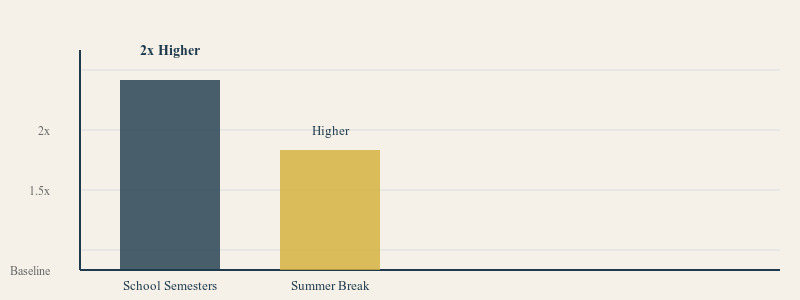
According to CDC data from 2018 to 2023, emergency department visits for child mental and behavioral health concerns are up to twice as high during school semesters compared to summer. But here’s the catch: summer is not stress-free for families. It’s a different kind of stress.
The Summer Paradox
A UK study following over 16,000 children found that children’s mental health actually worsened across summer holidays.
For teenagers specifically, summer brings unique pressures: social overload (intensified peer interactions), body dissatisfaction (swimming season, social comparisons), and unstructured time that can fuel anxiety.
Human brains, especially developing brains, thrive on routine. School provides structure: wake-up times, transitions, peer interaction, teacher feedback, natural rhythm. Summer removes that scaffolding. For children with anxiety or ADHD, this shift can be destabilizing.
How Parental Burnout Becomes Child Anxiety
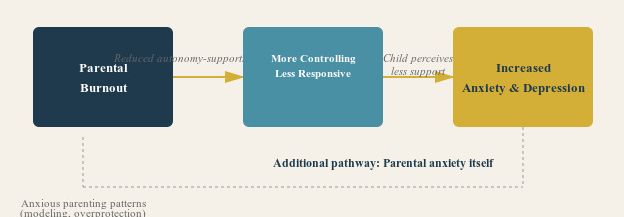
The connection between parental burnout and child anxiety is not hypothetical. Research shows concrete, measurable pathways through which parental overwhelm translates into childhood anxiety and depression.
The Mechanism: How Stress Travels
Three Key Pathways
Reduced Autonomy Support
Burned-out parents become more controlling and less responsive. Children feel less supported and more anxious. Research found this mediates the relationship between parental burnout and child anxiety symptoms, measured two months later.
Modeling Anxiety
Both maternal and paternal anxiety predict child anxiety through anxious rearing behaviors: excessive worry, overprotection, and modeling fearful responses. Children learn anxiety from watching and imitating their parents. Learn more about how social anxiety develops in children through parental modeling.
Family Stress Accumulation
Cumulative family stress, particularly financial pressures in the first five years of life, significantly predicts child anxiety at age 5. Stress compounds across the family system.
Genetic and Behavioral Matching
Children are most likely to develop the same anxiety subtype as their parent (social anxiety, generalized anxiety, etc.). A large Swedish study (N = 516,134) found parental anxiety modestly increased child anxiety risk by 27-49%.
Research also shows the flip side: when parents address their burnout, use cognitive reappraisal, and increase autonomy-supportive parenting, children’s anxiety decreases. The pathway works both directions.
If you’re noticing increased anxiety or behavioral challenges in your children this summer, the solution isn’t necessarily more activities or camps. It’s addressing parental stress first. At Aspire Psychological Group in Upper Saddle River, we frequently work with Bergen County parents who find that when they reduce their own burnout, their children’s anxiety naturally decreases. You don’t have to manage this alone, and your struggles don’t mean you’re failing as a parent.
The Power of Routine: Why Structure Matters More Than You Think
One of the biggest shifts from school-year to summer is the loss of routine. Wake times shift. Meal times become unpredictable. Sleep schedules change. Bedtimes drift later. For many families, the entire rhythm of daily life becomes fluid.
This isn’t a small thing. A meta-analysis of 53 studies spanning over 900,000 participants found that daily routine disruptions were significantly associated with increased depression, anxiety, and psychological distress in children. Children with anxiety often become avoidant, and the loss of structure can amplify this pattern. You can read more about how avoidance maintains anxiety in our guide to school refusal and avoidance.
The Research on Disruption
When daily routines break down, the research is clear: children’s behavior gets worse, mood declines, and anxiety increases. The strongest effects show up when sleep gets disrupted, physical activity disappears, or meal times become chaotic.
In vulnerable populations: Low-income families with preschoolers showed a striking pattern: structured family routines were significantly associated with better child emotion regulation. This protective effect was especially strong for children with altered stress biology (those showing heightened cortisol reactivity).
What Changes When Routine Breaks Down
Child Behavior Worsens
Daily disruptions to school and care routines predicted worse child behavior, increased tantrums, increased defiance, and greater emotional dysregulation.
Parental Mood Declines
Parents experience more negative mood and frustration when daily structure vanishes. Your irritability increases, patience decreases, and you’re more reactive to minor misbehaviors.
Discipline Becomes Harsher
When children are dysregulated and parents are depleted, punishment escalates. Harsh parenting becomes more likely, which further increases child anxiety and behavioral problems.
Family Conflict Increases
Loss of structure predicts decreases in family cohesion, increases in family conflict, and increases in harsh discipline. These changes uniquely predicted subsequent child maladjustment.
You don’t need to fill every hour of summer with structured activities. But research suggests protecting three core routines pays disproportionate dividends: consistent sleep and wake times, regular mealtimes, and daily physical activity. These three elements buffer anxiety and behavior problems even when other things are chaotic.
You don’t need to plan every minute. In fact, unstructured play is valuable. But the research is clear: protecting sleep, meals, and physical activity is not optional. These aren’t luxury items. They’re the foundation that allows everything else to work. In Northern New Jersey, families often struggle with summer planning. The solution isn’t more camps or activities. It’s consistency in these three areas, even when school isn’t structuring your day.
Who Is Most at Risk for Summer Burnout?
Not all families experience parenting burnout equally. Research identifies specific groups at heightened vulnerability.
High-Risk Groups
Mothers More Than Fathers
Mothers consistently report higher burnout. Gender role inequality in childcare becomes more pronounced when school-based structure disappears. Mothers are often the “default parent” during summer.
Low-Income Families
Lower income is directly associated with higher burnout. Families lack access to camps, childcare, and enrichment activities. Mental health inequalities widen over summer for low-income children.
Parents of Children with Special Needs
Particularly parents with children with multiple or comorbid conditions. Summer means loss of school-based therapeutic services, adding to parental burden and stress.
Unemployed or Underemployed Parents
Parents without stable employment show substantially heightened burnout. Pre-existing mental health conditions (depression, anxiety) also significantly increase burnout risk.
Younger Parents
Younger parents (under 30) experience more burnout, especially those using avoidance or emotion suppression as coping strategies and those with sleep problems.
Personality Factors
Higher burnout in parents with high neuroticism, perfectionism, low self-esteem, need for control, insecure attachment, or difficulty identifying emotions (alexithymia).
A Protective Factor: Self-Compassion
Interestingly, Black and Hispanic parents in the U.S. demonstrated higher self-compassion than white parents, which buffered burnout despite facing more structural stressors. This suggests that how we talk to ourselves matters. Individual coping, of course, cannot substitute for structural change. But cultivating self-compassion is a lever parents can control.
Evidence-Based Solutions: What Actually Works
The good news: research has identified specific intervention components that reduce parenting burnout and consequently reduce child anxiety. You don’t need to overhaul your life. These are evidence-based, tested approaches.
Five Essential Components of Effective Interventions
A 2025 meta-analysis examined 15 studies (1,380 participants) testing various burnout interventions. Five components appeared consistently in effective programs:
Psychoeducation
Learning what parenting burnout is, how it differs from depression or job burnout, normalizing the experience, and understanding the BR² framework (risks vs. resources). Naming what you’re experiencing is therapeutic.
Self-Regulation and Stress Management
Training in cognitive reappraisal (reframing stressful situations) and reducing rumination. Mindfulness works through two pathways: increasing self-compassion and shifting from abstract worry to concrete, present-moment awareness. Even an 8-week meditation program significantly reduced burnout and increased resilience.
Values and Identity Work
Reconnecting with your core parenting values and sense of identity beyond the parenting role. Burnout often stems from role fusion: when you are only a parent, and parenting is not going well, everything feels like failure.
Experiential Practice
In-session and between-session exercises practicing new skills in real parenting scenarios. This automates cognitive reappraisal and reduces its cognitive cost. Over time, new responses become automatic.
Relational Awareness
Addressing co-parenting relationships and parent-child interactions. Improving perceived co-parenting support is the most readily changeable cognitive appraisal and causally reduces burnout. Sharing positive moments with children directly reduces emotional distancing.
Program Duration and Format
Sweet spot: Six-week programs work well for busy families. You’re not signing up for six months of intensive therapy. Most people see real improvement within that timeframe.
Format doesn’t matter as much as content: Whether the intervention is CBT-based, mindfulness-based, educational, or focused on resources-building, the five components above predicted effectiveness more than the specific modality. Choose the format that fits your life.
Cognitive Reappraisal: The Single Most Protective Factor
Across 22 countries and 8,225 parents, a pattern emerged: cognitive reappraisal weakened the stress-to-burnout link while rumination amplified it. At the within-person level, burnout itself erodes cognitive capacity, creating a vicious cycle.
But here’s the leverage point: reappraisal can compensate for the absence of social support. If your partner isn’t emotionally available, if family is distant, or if you lack community: learning to reframe isn’t a substitute, but it’s a powerful tool.
When you think: “My child is being defiant. I’m failing as a parent. Everything is falling apart.”
Try instead: “My child is struggling right now. This is hard, but it’s temporary. I can handle this. I’m going to take a breath and figure out the next right step.”
You’re not changing what’s happening. You’re changing how you react to it. That shift changes everything.
You don’t need to hire an expensive therapist or commit to months of intensive treatment to reduce parenting burnout. A 6-week program focused on the five components above can produce significant, lasting change. For Bergen County and Rockland County families, parent coaching often proves more accessible and just as effective as traditional child-focused therapy. The goal isn’t perfection. It’s learning to shift your relationship to stress, reconnect with your values, and create new patterns that serve your family better.
Practical Summer Strategies: What You Can Do This Month
The research is clear. The following strategies are evidence-backed ways to reduce burnout and child anxiety this summer. You don’t need to do all of them. Choose one or two that fit your family.
Strategy 1: Protect the Three Non-Negotiables
Target: Sleep, mealtimes, and physical activity.
You can let other things be flexible. Summer bedtimes can be negotiable. But consistent sleep and wake times, regular mealtimes, and 30-60 minutes of physical activity daily buffer anxiety better than any expensive camp or activity. For families with limited resources, this is the highest-leverage move.
Strategy 2: Create a Structured Week (Even Without School)
Target: Reduce decision fatigue and anticipatory anxiety.
Your children’s brains still need rhythm. Monday through Friday, you can follow a loose structure: certain days are park days, certain days are friend-at-home days, certain mornings start with screen-time. This doesn’t mean rigid scheduling. It means rhythm and predictability.
Strategy 3: Practice Cognitive Reappraisal in Moments of Stress
Target: Interrupt the stress cycle before it accelerates.
When your child is crying, fighting with a sibling, or refusing to cooperate, pause. What’s the thought that’s triggering your stress? “I can’t handle this” becomes “This is hard. I can take a breath and respond thoughtfully.” That one reframe changes your physiology.
Strategy 4: Increase Positive Co-Parenting Communication
Target: The most proven burnout reducer.
If you’re partnered, one of the most effective interventions is explicit appreciation and support: telling your partner that you see them working hard, that you notice parenting efforts, that you’re in this together. Research shows this causally reduces burnout scores. Ten seconds of “I noticed you handled that really well” pays dividends.
Strategy 5: Build in Non-Parenting Time
Target: Identity beyond parenthood.
Burnout is partly about losing yourself in the parenting role. Can you protect even 2-3 hours per week for something that’s just yours? Not self-care (meditation, baths). Something that makes you feel like yourself: a hobby, time with friends, professional engagement. The data shows this directly reduces emotional distancing from your children.
Strategy 6: Normalize and Name Anxiety
Target: Reduce child and parental anxiety simultaneously.
Tell your anxious child: “Everyone feels nervous sometimes. Your brain is trying to keep you safe, and that’s its job. But sometimes it gets a little too worried. We’re going to practice being brave together.” This normalizes anxiety, teaches her it’s a brain thing (not a character flaw), and frames the parent-child relationship as a team.
You don’t need to overhaul your entire parenting approach. Pick one strategy from above that resonates with your family’s situation. Maybe it’s protecting sleep and meals. Maybe it’s learning cognitive reappraisal. Maybe it’s increasing positive moments with your co-parent. One genuine change, sustained over six weeks, can shift the entire system. Upper Saddle River and Bergen County families often find that once they commit to one specific change, everything else becomes easier because the parental stress itself decreases.
Related Reading
Deepen your understanding of childhood anxiety and parenting interventions:
School Refusal: What Parents Need to Know
Learn how avoidance patterns develop in anxious children and evidence-based approaches to support return to school.
Understanding Childhood Anxiety Disorders
A comprehensive guide to recognizing anxiety in children and understanding the difference between normal worry and clinical anxiety.
SPACE Treatment: Parent-Focused Anxiety Intervention
Deep dive into the evidence-based SPACE protocol for reducing family accommodation and childhood anxiety.
Social Anxiety in Children and Teenagers
Explore how social anxiety develops, why it differs from shyness, and parent-coached interventions that work.


